
Adventurous Kate contains affiliate links. If you make a purchase through these links, I will earn a commission at no extra cost to you. Thanks!
Is Dominica worth visiting? After six challenging days on the island, my honest answer is: only for a certain kind of traveler.
My husband Charlie and I visited Dominica in December 2025, and it was the toughest stop by far on our four-week trip across the Caribbean.
We dealt with some of the worst roads I’ve ever experienced, nearly constant rain, and a horrible last night spent searching for food near the airport.
Part of the problem was our expectations. Almost everything I’d read about Dominica in travel media, from “the nature island” tagline to the gorgeous waterfall roundups, made it sound like an unspoiled paradise, the ultimate gem, the place that would be everyone’s favorite island if only they knew it existed.
I knew not to expect great beaches. What I didn’t know was how much effort it would take just to get from one place to another, or how stressful those drives would be.
Planning your trip to Dominica soon?
Dominica’s tourism is growing every year, and many small guesthouses and tours fill up quickly. Book ahead to avoid disappointment!
🌴 Top Experiences and Tours in Dominica:
- VIP Tour: Trafalgar Falls, Sulfur Spa, and Beach (Includes my favorite hot spring!)
- Waterfalls, Titou Gorge, and Spa (Cool gorge swimming and my fave hot spring)
- Waitukubuli Volcano Snorkeling (Unique snorkel adventure)
🛌 Top-Rated Hotels in Dominica:
- Secret Bay (THE best small luxury hotel on the island)
- Kootney Resorts (I stayed here — nice midrange cottages in Portsmouth)
- Fort Young Hotel (Small hotel with infinity pool in Roseau)
- Ti Kwen Glo Cho (Spend one night at these hot springs!)
📱 Best Dominica eSIM: I recommend an Holafly eSIM to stay connected in Dominica. Get 5% off with code HOLAKATE.
🚗 Renting a car in Dominica? Find deals on car rental rates here (but make sure you read about the reality of driving here first).
I’ve wondered for so long if I should even write this post. Not because I struggle to tell the truth — the number-one thing I hear from my readers is “You’re so honest!” — but because I don’t want to hurt a struggling island.
Dominica is still rebuilding after Hurricane Maria, and Dominicans are working hard to grow their tourism industry the right way. The last thing I want to do is punch down.
I’ve realized the most useful thing I can do is be honest but fair about the mistakes we made and what you should do differently on your trip, dear readers.
So grab yourself a cup of tea and sit back to read about one of the most lush and vibrant places I’ve ever visited: an island that is spectacularly beautiful, often deeply frustrating, and full of wonderful people who deserve a break.
This post was published in November 2026.
Table of Contents
Is Dominica underrated, or unpopular for a reason?
Dominica occupies a unique position in travel media. Most people don’t know this island even exists, or they mix it up with the Dominican Republic.
It’s easy to see why. Dominica has no big, sandy beaches and very few large beach resorts, which keeps away mass-market tourism. Its small airport can’t handle large jets, so getting here usually means connecting through another island.
Most visitors arrive on cruise ships, spend a few hours on an excursion, and leave by dinnertime. Even some Caribbean aficionados haven’t heard of Dominica.
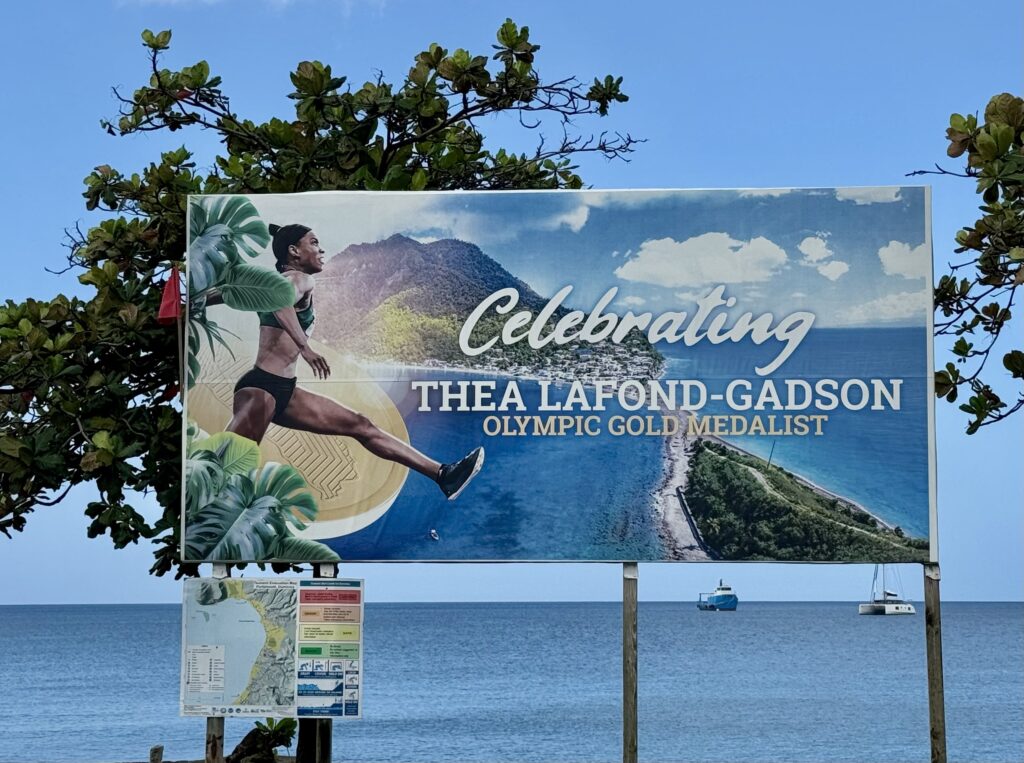
Dominicans are well aware of this. Thea Lafond-Gadson won Dominica’s first-ever Olympic medal, a gold, in the triple jump at the 2024 Summer Olympics in Paris, and I remember her press conference immediately after:
Okay, we’ll start with the basics. My country’s name is Dominica. We are not Dominican Republic, so it’s pronounced differently. We are about roughly 70,000 people, not 7 million, not 70 million, 70,000. And it is a gorgeous, gorgeous gem in the Caribbean.
And among the travel writers who DO know Dominica, the coverage is almost universally glowing.
Dominica is “the nature island.” Dominica is the greenest island. Dominica is the “most authentic” Caribbean island (if there were a measure for authenticity, but I digress…) Dominica is the island of 365 rivers. Dominica is the Caribbean the way it used to be.
What you rarely read is what it’s actually like to get around, where to find food, or how much it rains. And it was in this context that I planned our trip.
Dominica has been through a lot.
The most important thing to know before visiting is that Dominica has gone through some very difficult times.
In 2015, Tropical Storm Erika caused deadly flooding and landslides. Two years later, Hurricane Maria destroyed homes and infrastructure across the island, with damage and losses estimated at 1.37 billion USD. Thirty people were confirmed dead; a similar number were reported missing.
The damage was more than twice the size of Dominica’s GDP. Imagine a single storm wiping out more than two years of everything your country produces.
Dominica is still rebuilding today, and a lot of what frustrated me as a visitor, especially the roads, traces back to the damage of those storms. It’s important to keep this context in mind as you read this post.
Our Itinerary
After doing some research, we decided we would fly in and out of Dominica, rent a car for the duration of our trip, and spend six nights based in Portsmouth, Dominica’s second city, in the northwest.
For accommodation, we booked Kootney Resorts, with cottage-style accommodation.
In terms of activities, this is what we chose to prioritize:
- Taking a boat ride on the Indian River
- Visiting Cabrits National Park
- Exploring Morne Trois Pitons National Park, the island’s sole UNESCO World Heritage Site
- Hiking to Middleham Falls
- Soaking in the hot springs in Wotten Waven
There is one prominent activity in Dominica we chose not to do: the Boiling Lake Hike.
Dominica is home to one of only two boiling lakes in the world (the other is in New Zealand), and that’s normally the type of activity I’d be keen to experience.
But the hike is very challenging, with lots of vertical climbs, and takes around 6-8 hours, and Charlie and I didn’t want to commit to a hike that was both long and difficult.
Another special activity in Dominica is swimming with sperm whales, but these are done as weeklong trips, not a day activity.
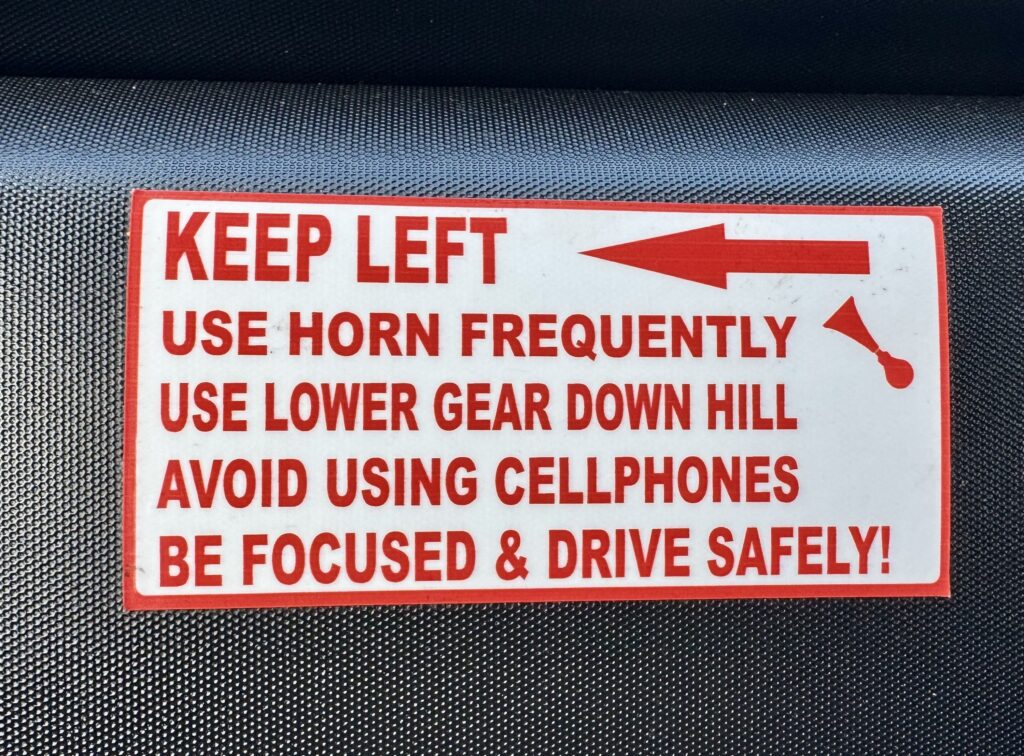
Arrival in Dominica
We arrived at Douglas-Charles Airport in Dominica via direct flight from Barbados and picked up our rental SUV.
In Dominica, they drive on the left side of the road. As Charlie is a Brit and I haven’t driven on the left in anything bigger than a Thai motorbike, we decided he would do the driving.
Dominica’s airport is located in Marigot, in the less-developed northeast of the island. This is far from Roseau, Dominica’s capital, largest city, ferry hub, and cruise port, which is in the southwest.
We set out for our accommodation in the town of Portsmouth, on the northwest corner of the island.
And so began one of the most terrifying drives of my life.
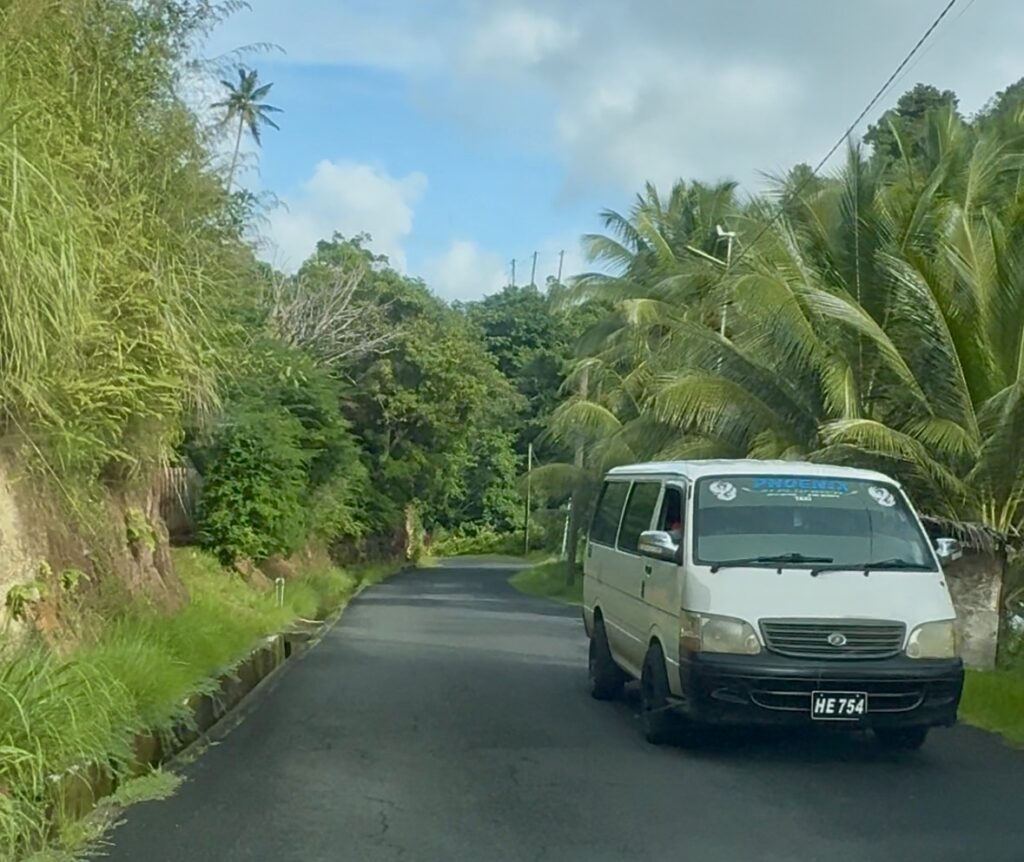
The roads between the airport and Portsmouth were in horrible condition — narrow, full of potholes, lots of switchbacks, and with deep trenches dug on each side. Not ordinary trenches. These were so wide that if you drove onto them, your car would flip over, and much of the time they were obscured by unkempt vegetation.
And that’s not all. Our flight had been delayed a few hours, so the sun set in the middle of our drive. We drove through the darkness as trucks, often with no lights on, passed us while beeping.
Charlie is a skilled driver — I trust him. But this drive was so frightening, I could barely move, my heart thudding the whole time. Google Maps said the drive would take around an hour; it took closer to two.
Once we arrived at our cottage, I collapsed in relief, my hands still shaking. And all I could think about was, We’ll need to drive BACK to the airport, too.
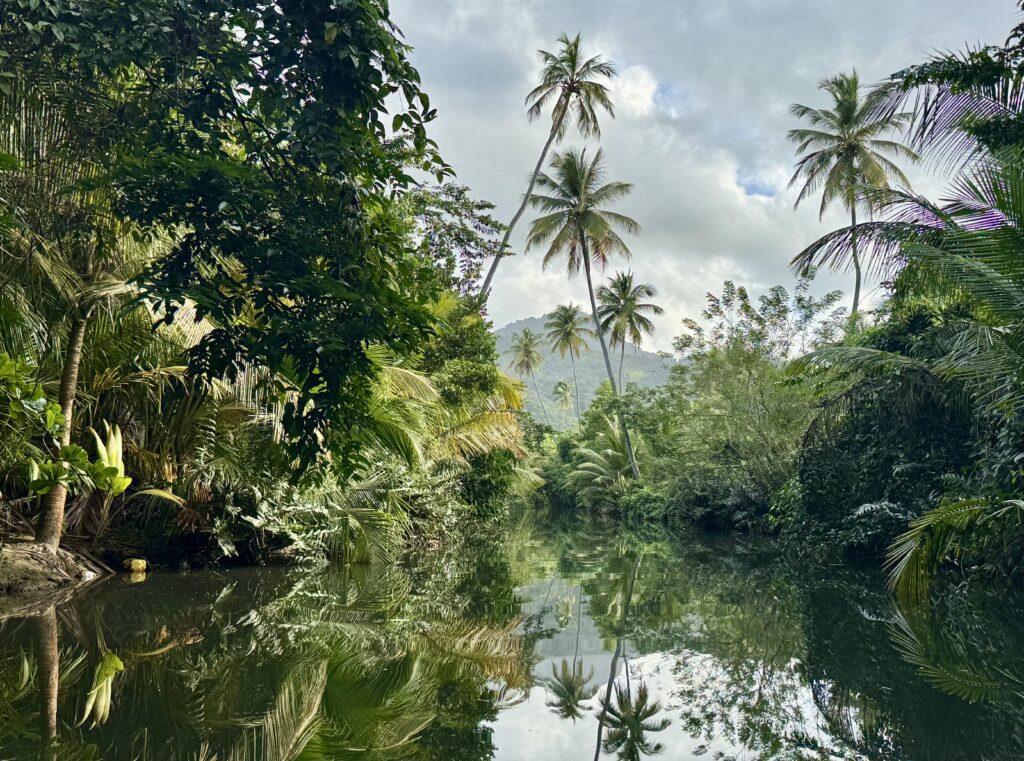
Settling In, and a River Journey
The owner of our cottage at Kootney Resorts, Trish, had told us not to worry about checking in that night and to just get some sleep and come by in the morning. So we walked to a Chinese restaurant down the street for a quick dinner of lo mein and fried rice.
A Chinese place? Yes.
Once you start noticing Chinese construction in Dominica, you see it everywhere: signs on building sites, Chinese crews, Chinese restaurants, and the massive new Chinese-built international airport under construction on the northeast coast.
This isn’t an accident. It goes back to 2004, when Dominica cut diplomatic ties with Taiwan in favor of Beijing. This triggered a wave of Chinese grant-financed infrastructure projects in Dominica.
China initially committed $112 million USD to Dominica in 2004; the projects have only increased since then. China also helped fund rebuilding after Hurricane Maria in 2017, including six new schools.
But why is China spending all this money? The Chinese government wants more nations to side with China and no longer recognize Taiwan. Dominica is one of many Caribbean nations where China is doing this. As always, China is playing the long game.
(This is a very interesting story, and The People’s Map: Dominica has a great read on it.)
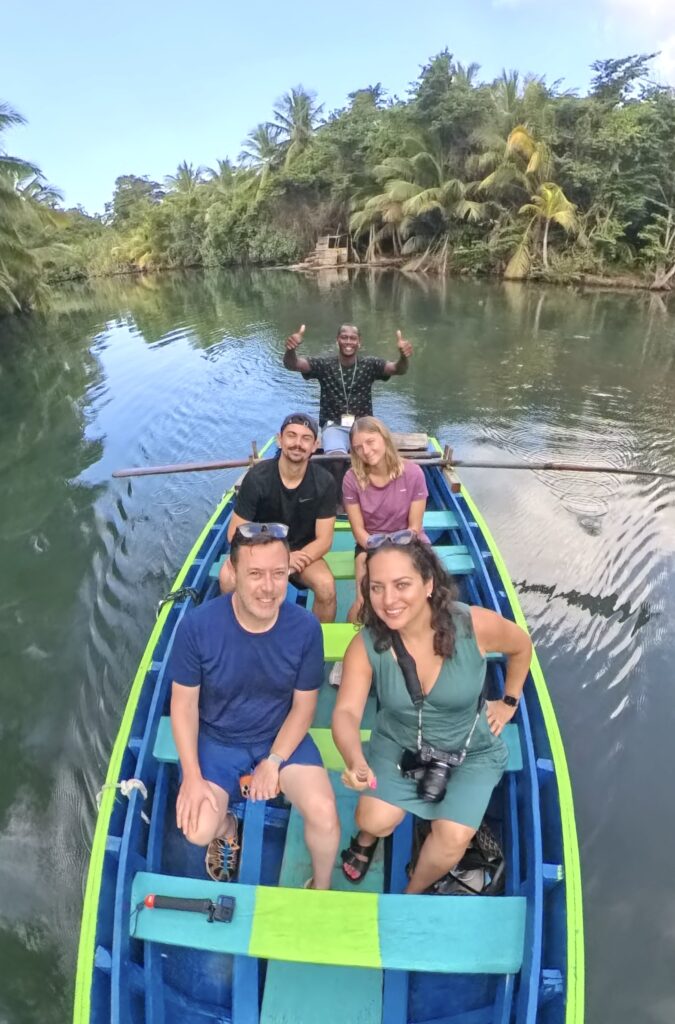
That next morning, we headed out for a riverboat trip with Indian River Tours at 8:00 AM. I had WhatsApped the company the night before, and our guide, Dexter, encouraged us to come for an early tour to enjoy the river before the cruise ship day-trippers showed up.
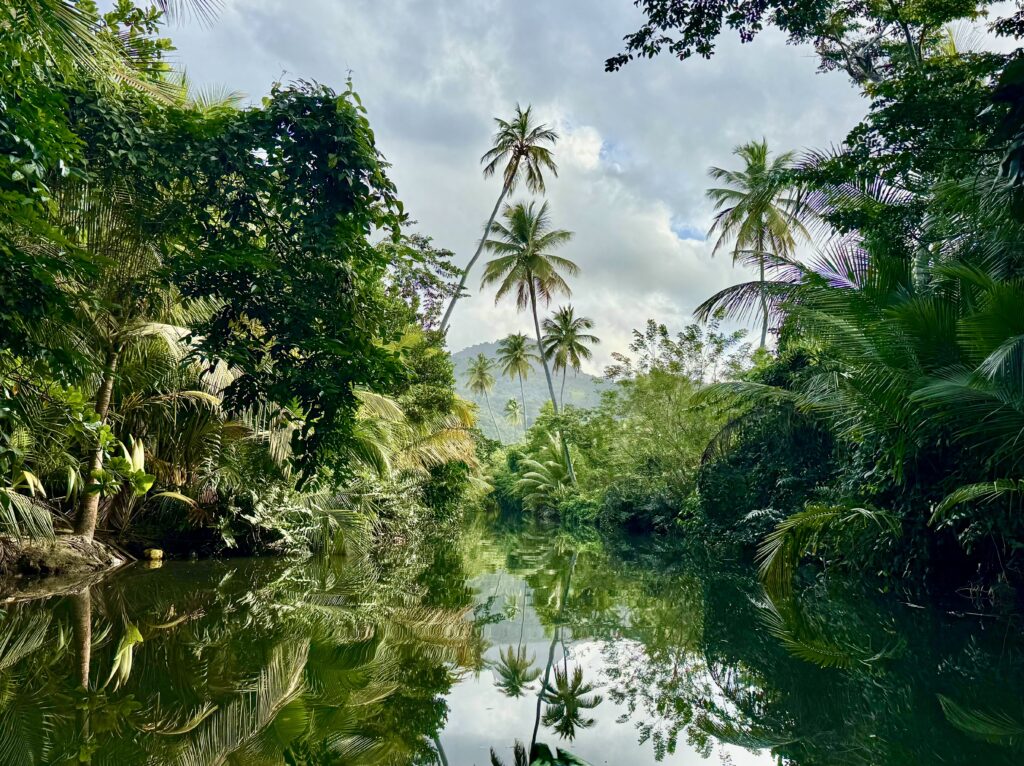
Together with a French couple, we glided down the peaceful Indian River, tall palm trees poking into the stormy sky. Dominica claims to have 365 rivers — though let’s just say they have a generous definition of “river” — and they give the landscape life.
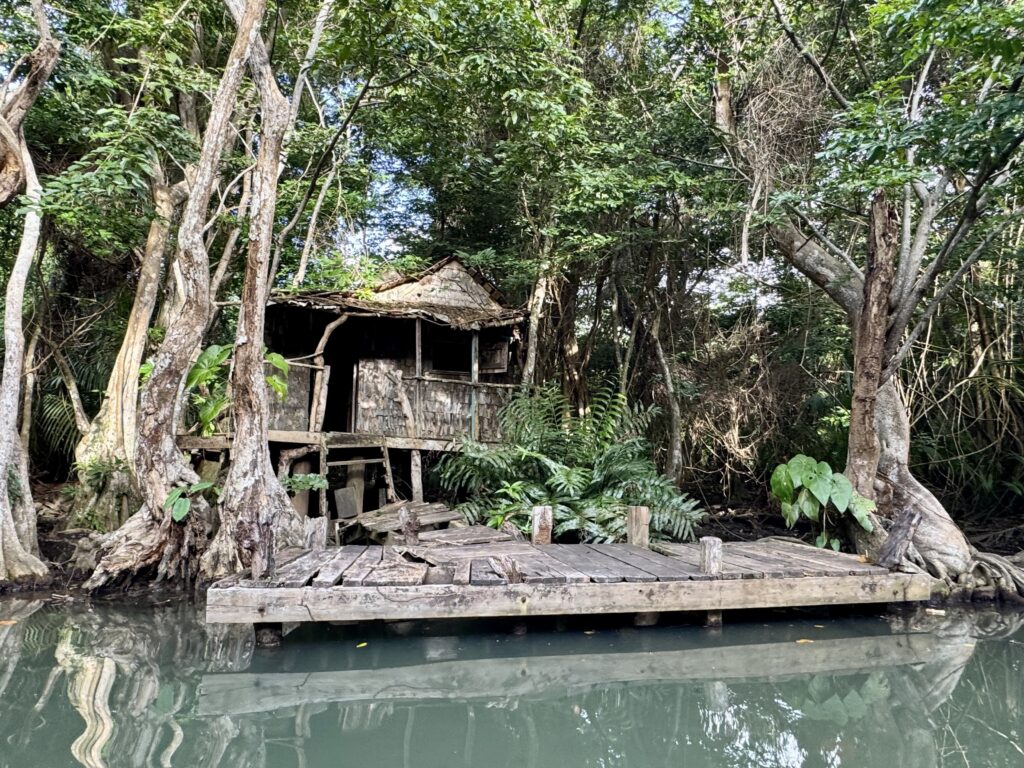
Pirates of the Caribbean: Dead Man’s Chest was shot in part here, and we got to see a piece of the remaining set: Tia Dalma’s shack!
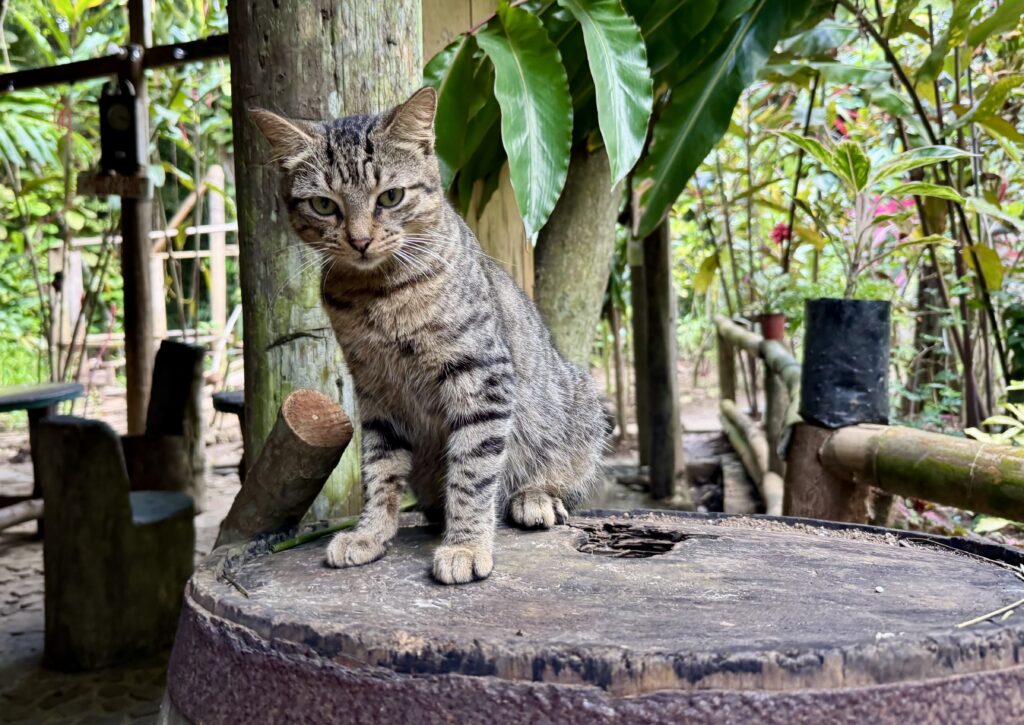
We arrived at our eventual destination, a bar set in the woods, where Dexter took us on a short walk. Charlie and I played with a little brown tabby cat we named Domingo (it was Sunday, after all!).
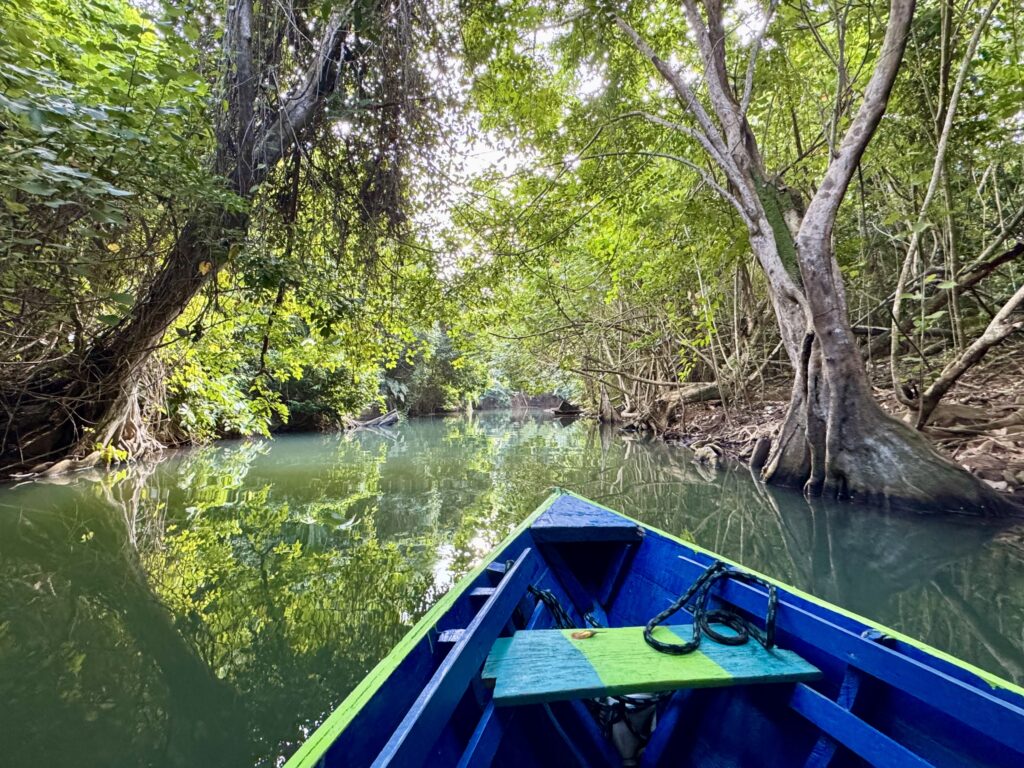
Our tour cost $25 USD each, or 68 East Caribbean Dollars (XCD). (Many places in Dominica quote prices in USD, but XCD is more widely accepted than USD and you will almost certainly get change in XCD.)
Dexter told us we had to buy a national park pass, and we got one at a nearby gas station. National park passes are either $5 USD for one site or $12 USD for one week.
After the river trip, we went for breakfast at a cafe called Water’s Edge, a lovely little spot in Portsmouth with hearty Dominican dishes and drool-worthy baked goods. Praise music blared on the radio as we devoured an enormous pair of cookies.
Next, we hit up a local grocery store for provisions, buying a little can of jerk Vienna sausages out of curiosity. A woman walked down the aisles, her phone on speakerphone, blasting a sermon.
If you somehow ended up in Dominica on a Sunday and had no idea which day of the week it was, I think you’d figure it out pretty quickly.
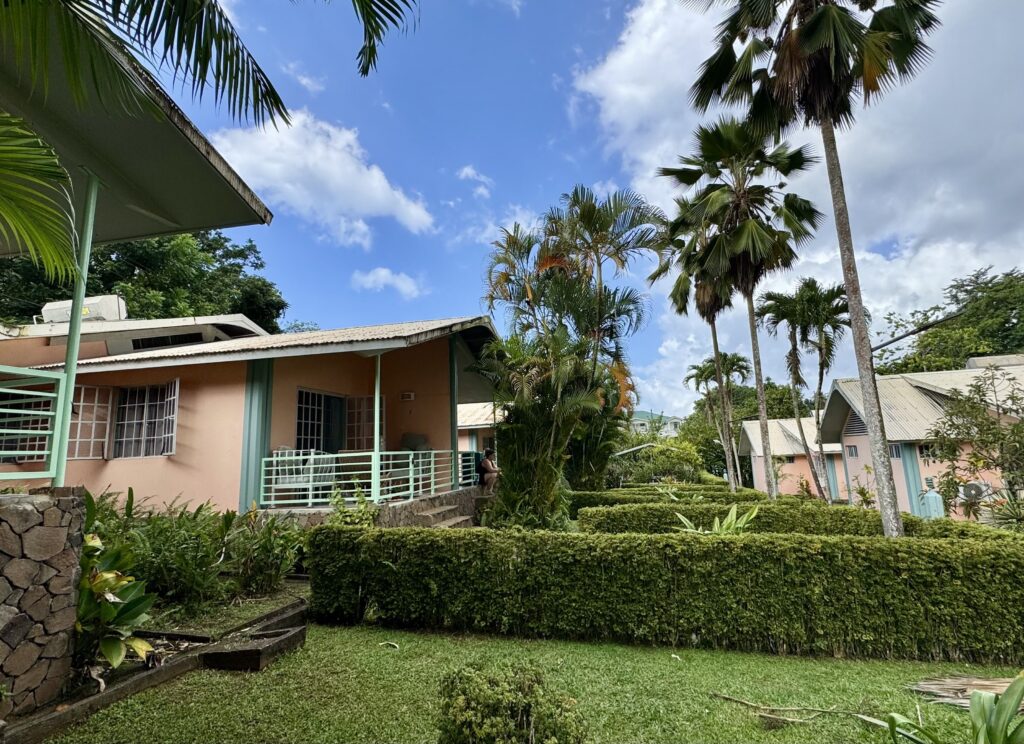
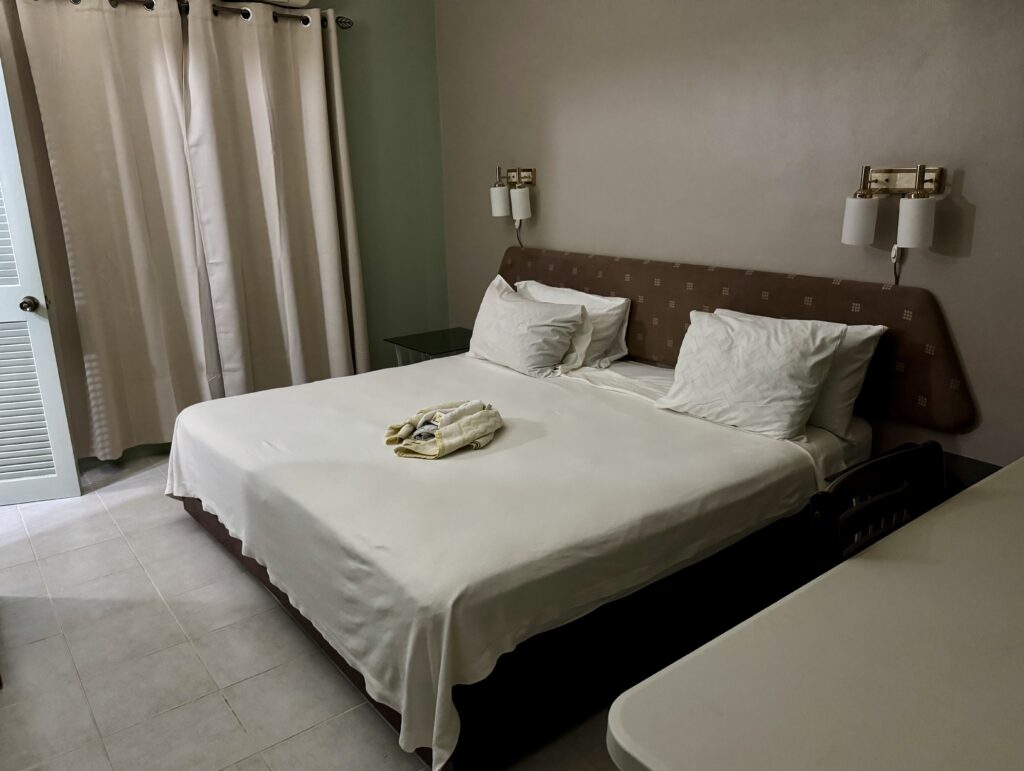
Back at Kootney Resorts, we checked in with the owner, Trish. A longtime expat living in Dominica, Trish welcomed us with big hugs, gave us travel tips, and encouraged us to swim or even bathe in the creek behind her house.
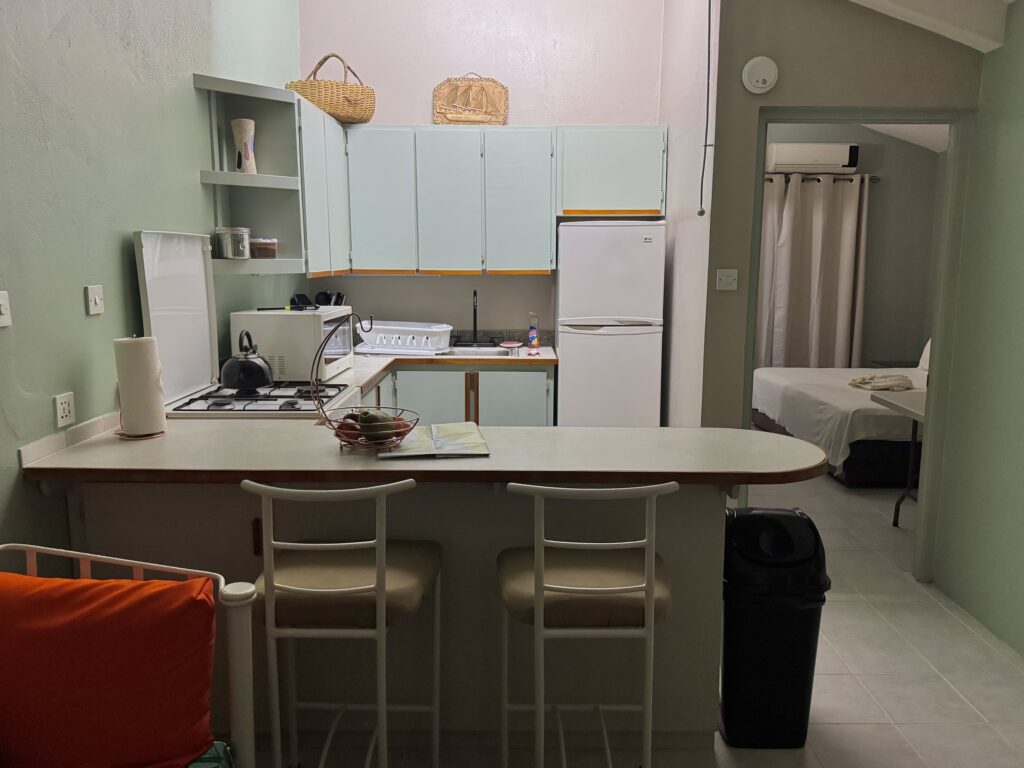
Overall, we liked our cottage — it had decent internet, good cooking equipment, the AC worked well, and the covered porch was nice, even when it rained. Restaurants and the grocery store were a quick drive or a 10-minute walk away.
I highly recommend this place if you want to stay in Portsmouth, and Trish is a lovely person.
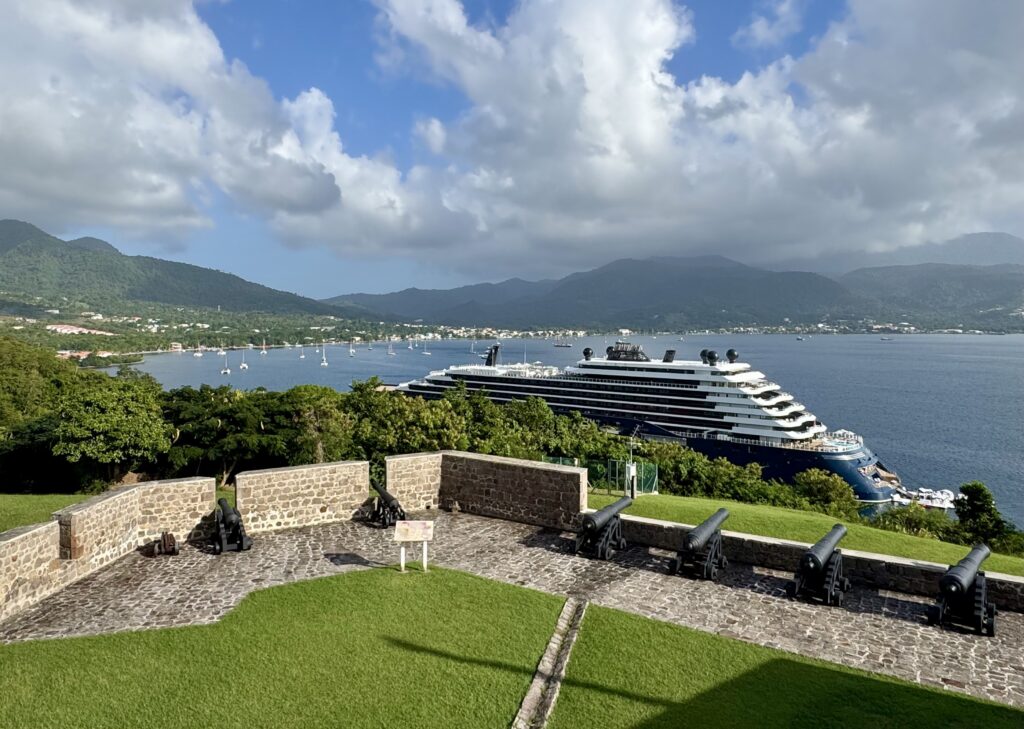
That afternoon, we made the short drive to Cabrits National Park. Located on the edge of Portsmouth, it’s the smallest of the three national parks on the island. Here we explored Fort Shirley, a British garrison edged with cannons.
That day, a Ritz-Carlton Yacht Collection ship was docked just off the park. (While most cruise ships dock in Roseau, some smaller ships dock here in Portsmouth.) And I won’t lie — it looked like a VERY NICE place to spend a vacation!
Cabrits National Park is also home to some short and easy hiking trails. We walked down a few of them.
To be honest, Cabrits National Park is nothing special — I don’t think it’s necessary to visit, and it’s definitely not worth paying for an additional national park pass unless you already have a weekly pass.
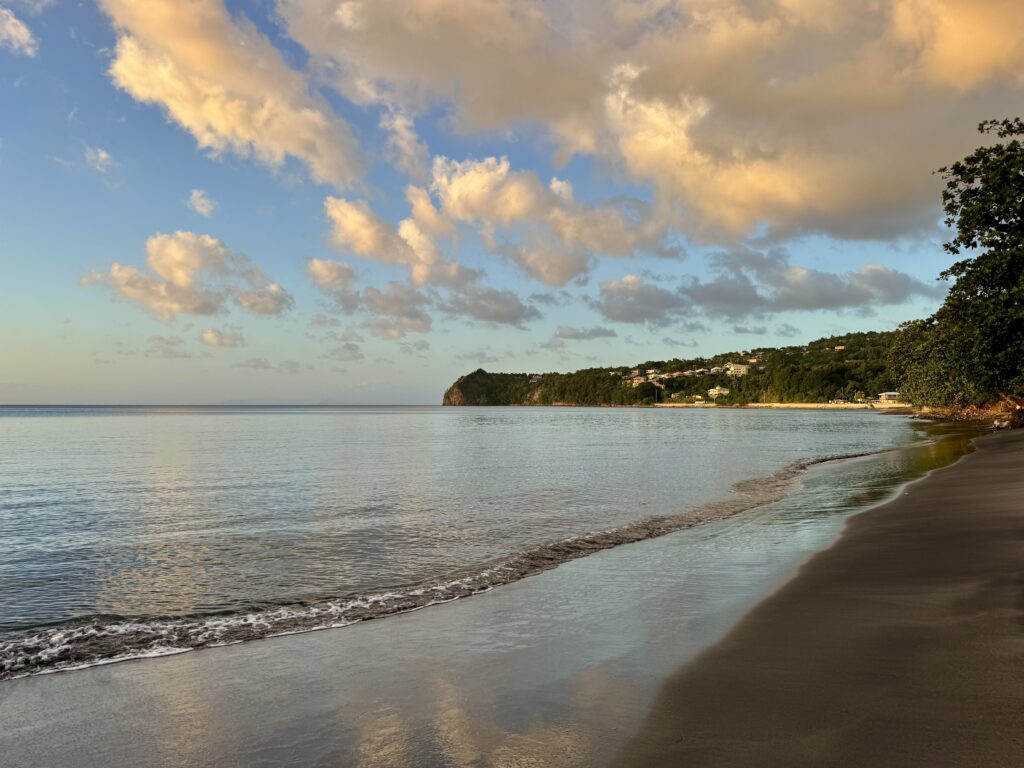
After the park, we drove up the coastline to the towns of Savanne Paille and Toucari, and once again I held my breath as Charlie drove those twisted, hilly, rugged roads.
But the journey was worth it. While the conventional wisdom is that Dominica is not a place you come to for beaches, there were actually a few nice ones up here.
The beaches themselves were narrow, with not much room to spread out, but they were pretty, with calm water and gorgeous sunset views.
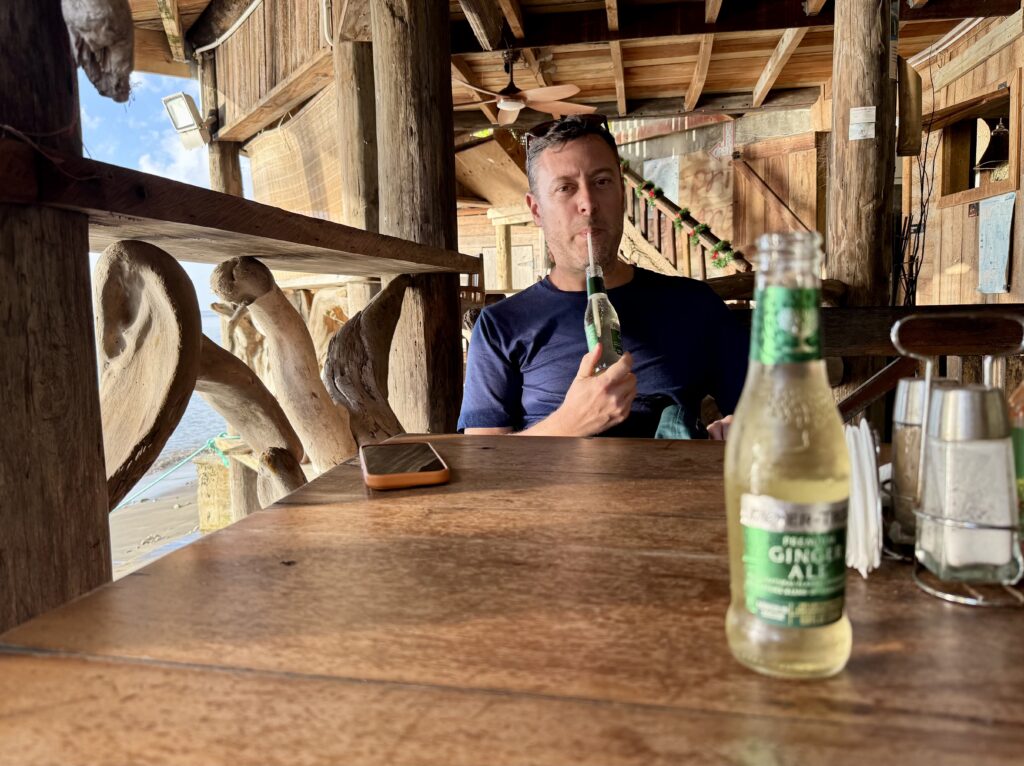
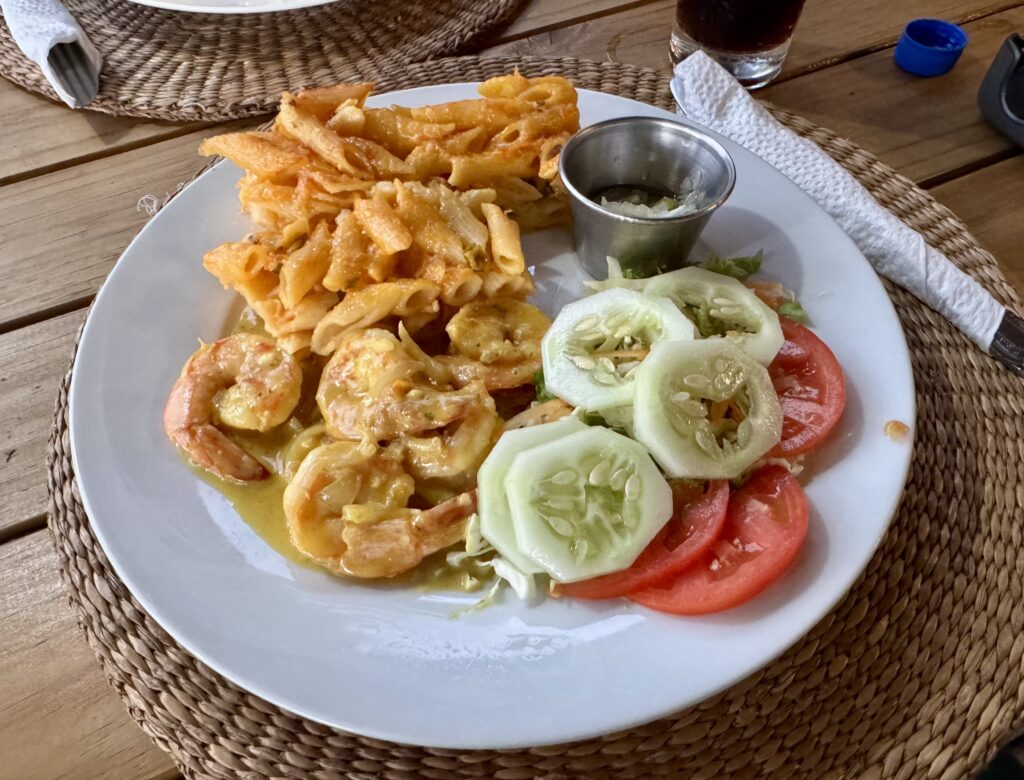
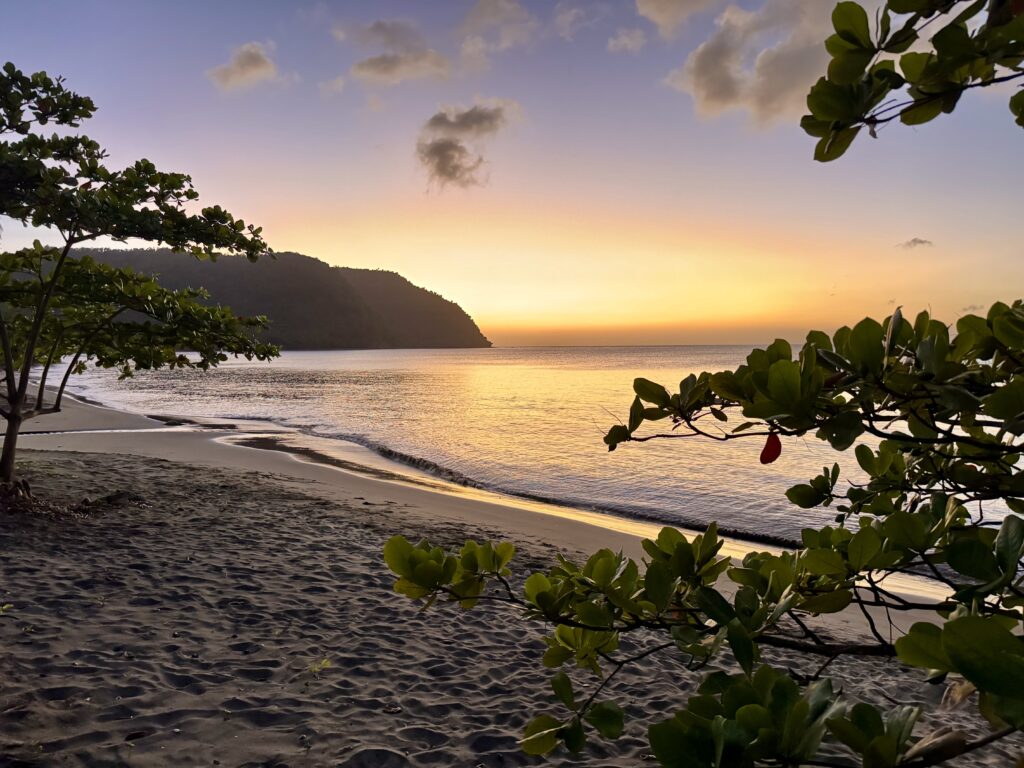
We grabbed some sodas at a beach bar called Keepin It Real and enjoyed shrimp and macaroni pie at Roots Rock Bar & Grill. The sunset that night was purple and lovely.
Also on this part of the island? The InterContinental Resort, with a long driveway leading up to the luxurious grounds. Charlie and I wondered if they offered day passes.
Oh, and they did. But something else came up first.
So Much Rain
By the time we arrived in Dominica, Charlie and I had been in the Caribbean for three weeks spanning late November and early December. We had a little bit of rain in Curaçao, Barbados, Grenada, and Martinique, but the showers were always brief and gentle.
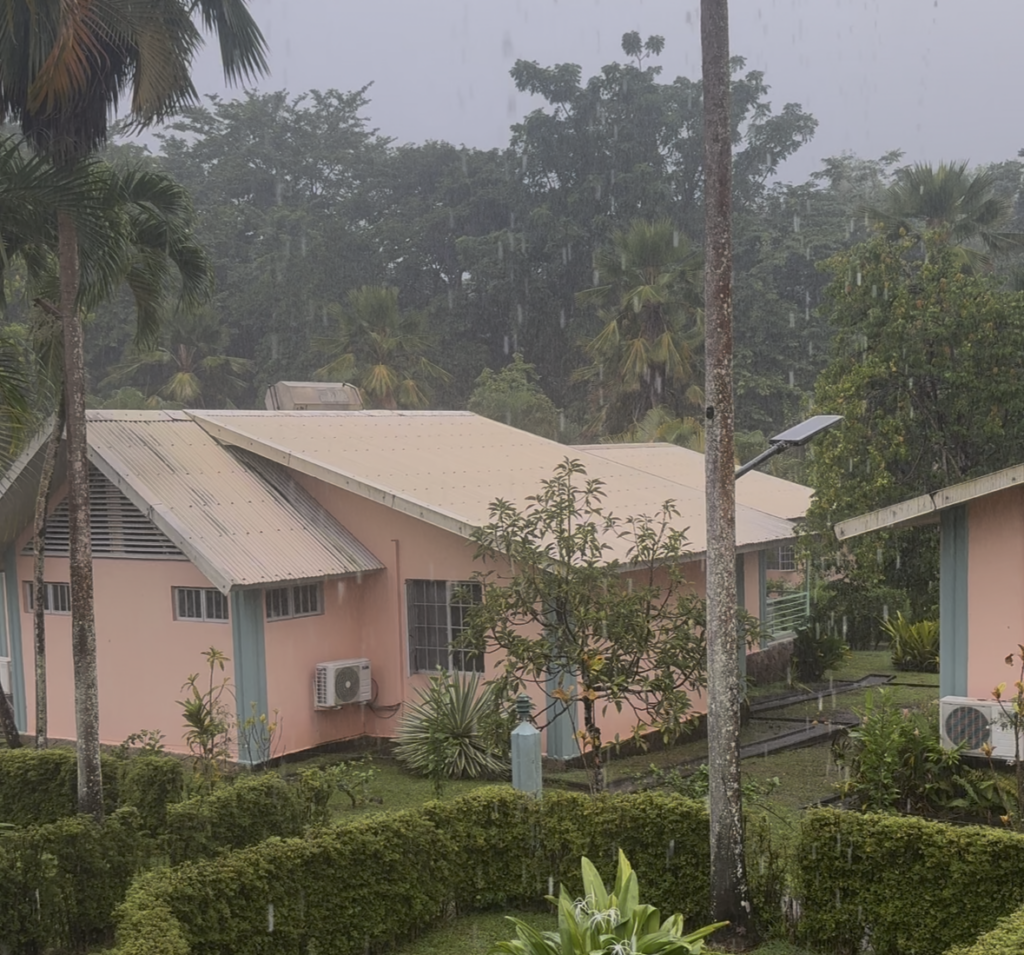
That wasn’t the case in Dominica. Here, the rain came down in sheets and lasted for hours.
On our second full day, it was pouring so hard that we only left our cottage to eat and get more groceries, and spent the rest of the time doing laundry and catching up on our inboxes.
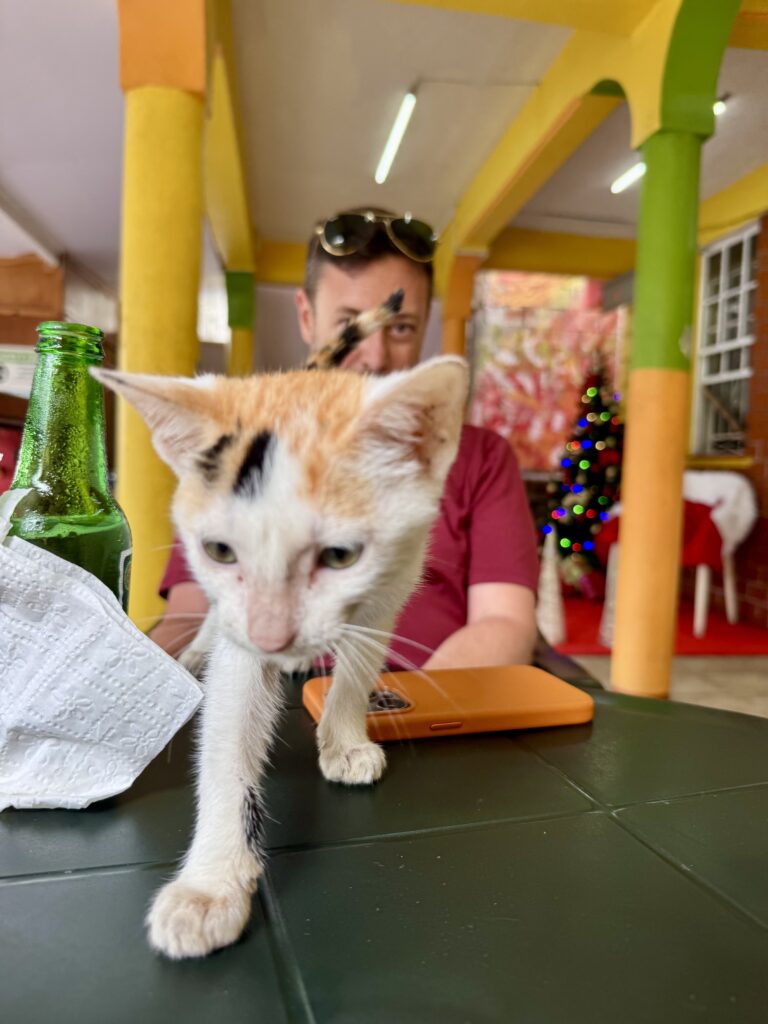
The day wasn’t a loss, though — we got some delicious shawarmas for lunch at a place called Kenan Shawarma King, and spent our meal cuddling a tiny calico kitten. After lunch, we bought a big bag of kitten food for the owner, who was delighted.
As it continued to rain over the next few days, I realized that our clothes weren’t drying. We were hanging them on a drying rack inside, and they were still damp days later.
And it’s not like I was washing jeans — I brought a wardrobe almost entirely made of thin performance merino wool, which usually dries in less than half a day. How do people even dry their clothes here?!
Dry season in Dominica is technically from December to May, but rain can happen anytime. We soon learned that it would pour throughout our trip.
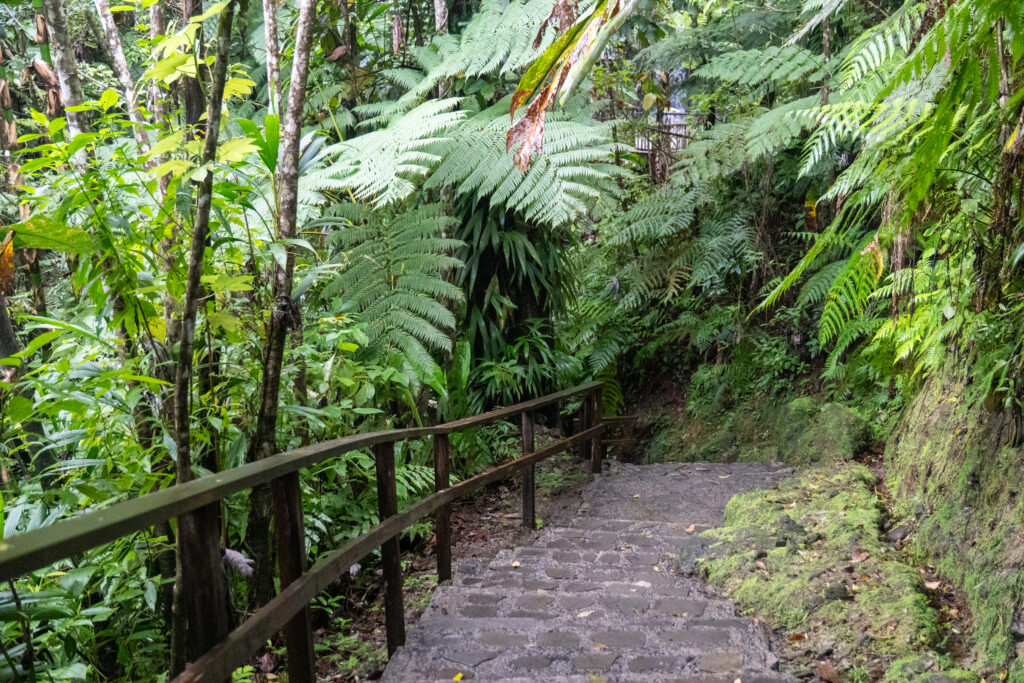
Exploring the Rainforests of Dominica
On our third full day, we decided to explore the interior of Dominica and spend the night in Wotten Waven, a town known for its geothermal activity.
Even though Wotten Waven was only an hour and 15 minutes from Portsmouth according to Google Maps, we figured it would be safer to stay over, rather than rushing to get back before dark.
As we drove southward toward Roseau, the road changed. The closer we got to the city, the wider and smoother the roads became.
Of course, it wasn’t without its challenges. Google Maps sent us down a few dead ends until we finally made it to the Emerald Pool in UNESCO World Heritage-listed Morne Trois Pitons National Park.
We parked nearby, spent about 15 minutes walking through the forest, and made our way down a staircase to the pool.
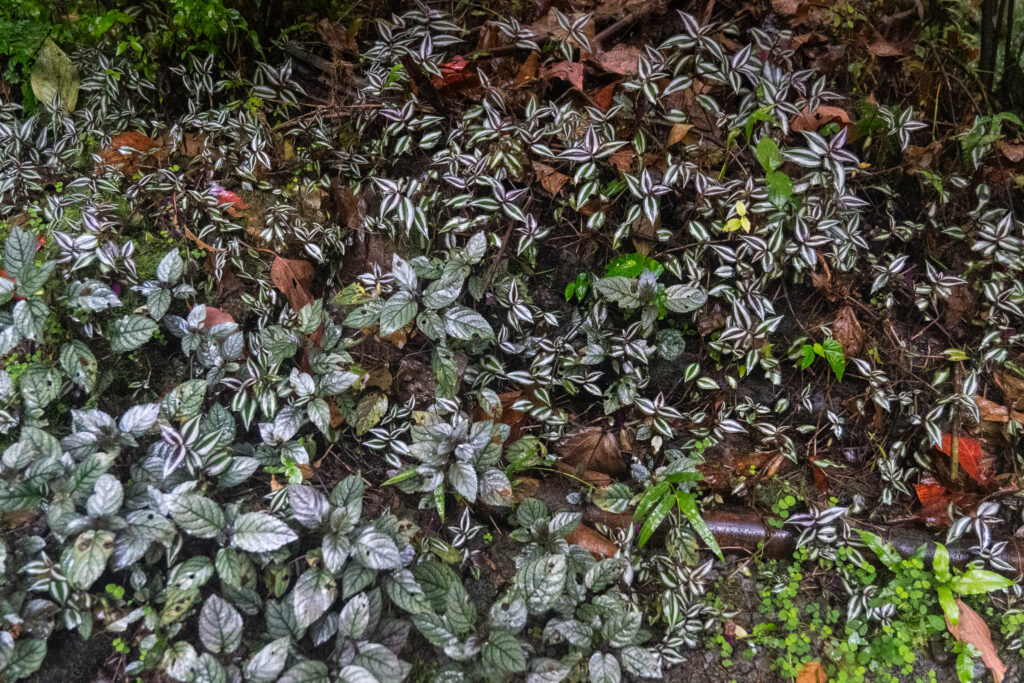
This is the kind of place that makes you appreciate Dominica — the lush, thick vegetation, rivers, and waterfalls. It feels like the jungle setting was turned up to eleven.
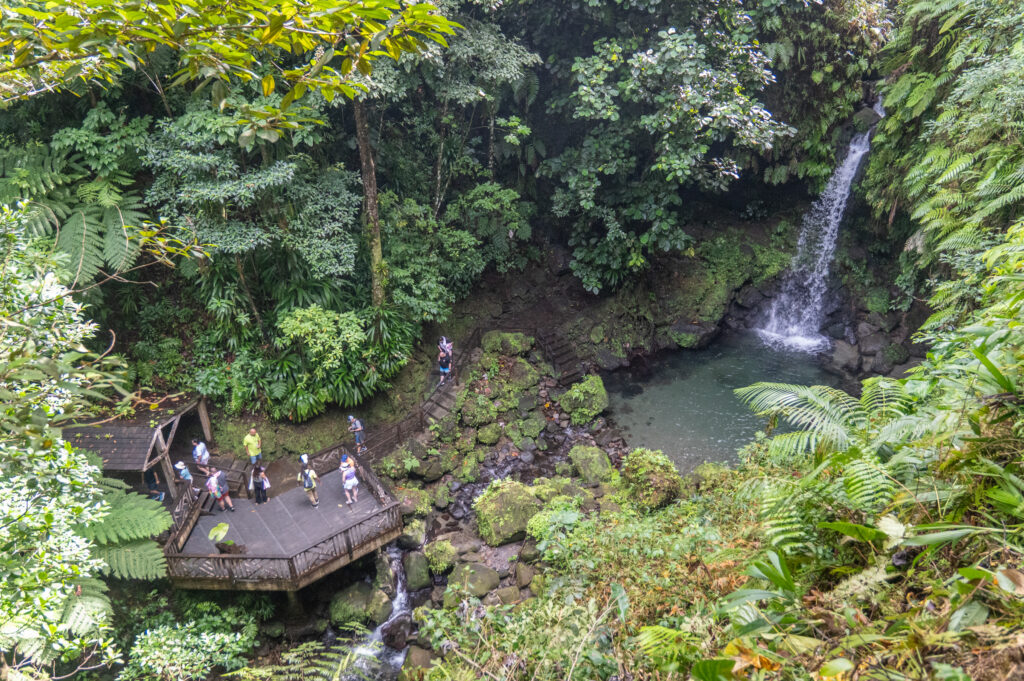
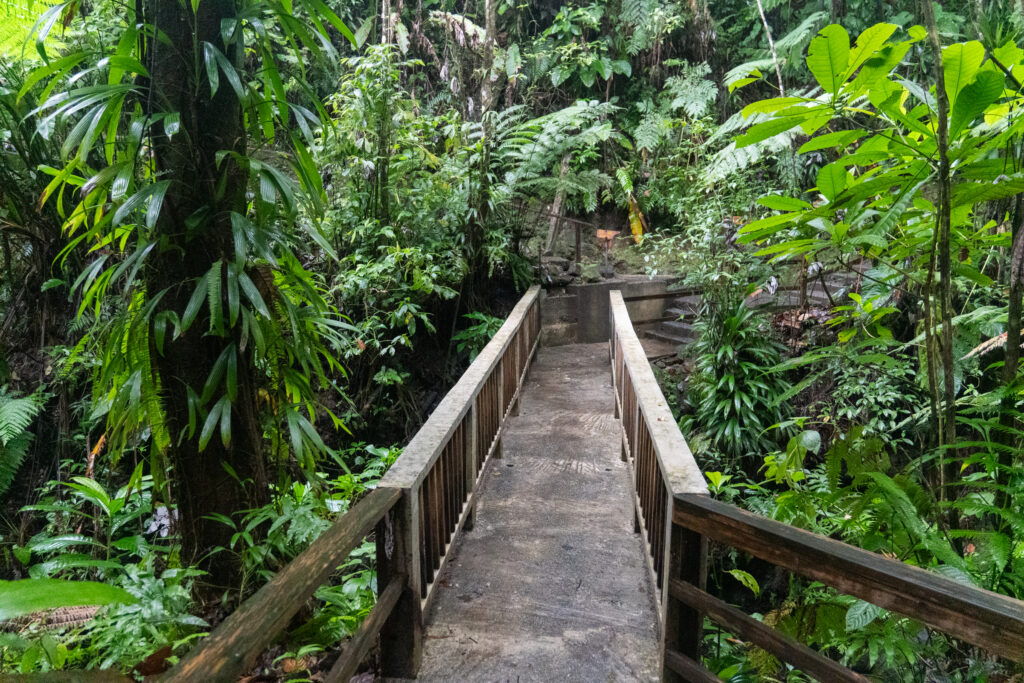
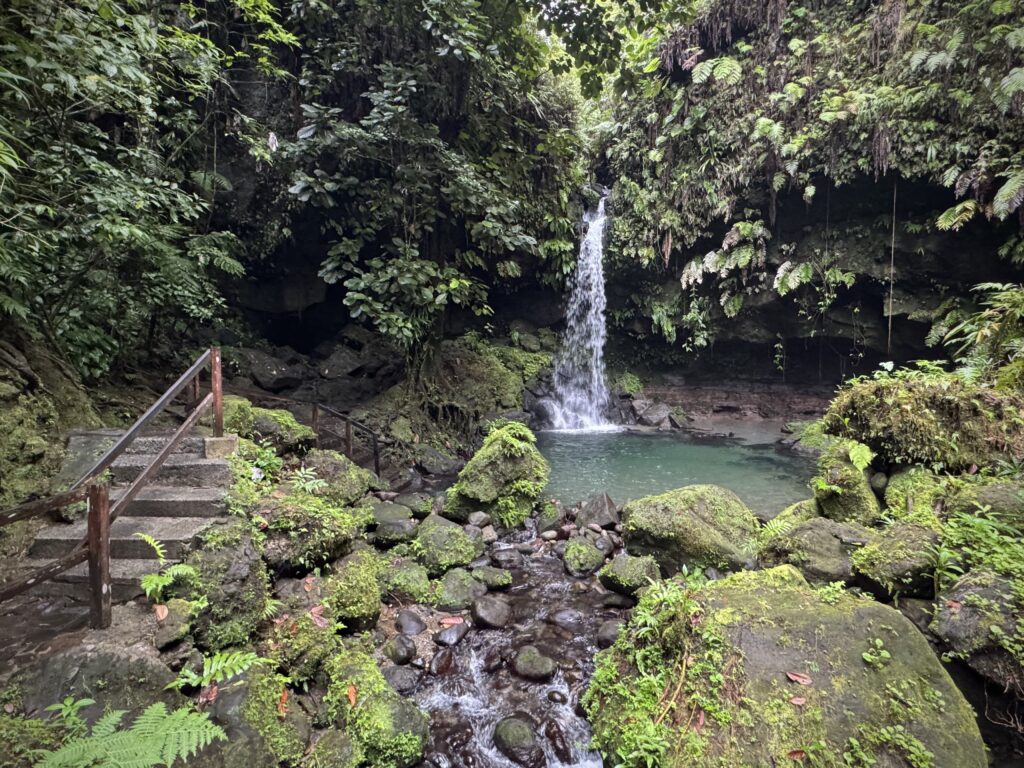
It was a beautiful place to visit — but not a place where you necessarily need to linger, unless you want to swim. We took our photos, enjoyed the atmosphere, and climbed back up.
The good thing is that we set out early and were able to beat the cruise ship excursions. Had we gone in mid-afternoon, our photos would have been full of bobbing heads.
Hiking to Middleham Falls
After grabbing lunch at another roadside restaurant (with yet another cat, of course), Charlie and I drove to the trailhead for Middleham Falls. While the Emerald Pool and Middleham Falls look close on a map, you actually have to drive all the way back to the west coast, then down another inland road.
We chose Middleham Falls for our hike in Dominica because we wanted a hike that was around medium difficulty and not more than a few hours, with a great visual payoff. It was also fairly close to our final destination of the day, Wotten Waven.
The road to the trailhead was the single worst road we experienced in Dominica. This was a dirt road so badly torn up that you had to creep along at a snail’s pace or risk popping your tires.
But it wasn’t a very long drive to the trailhead, and soon we were in the parking lot, looking at the wreckage of a half-built eco-resort with grass roofs that had been abandoned mid-construction.
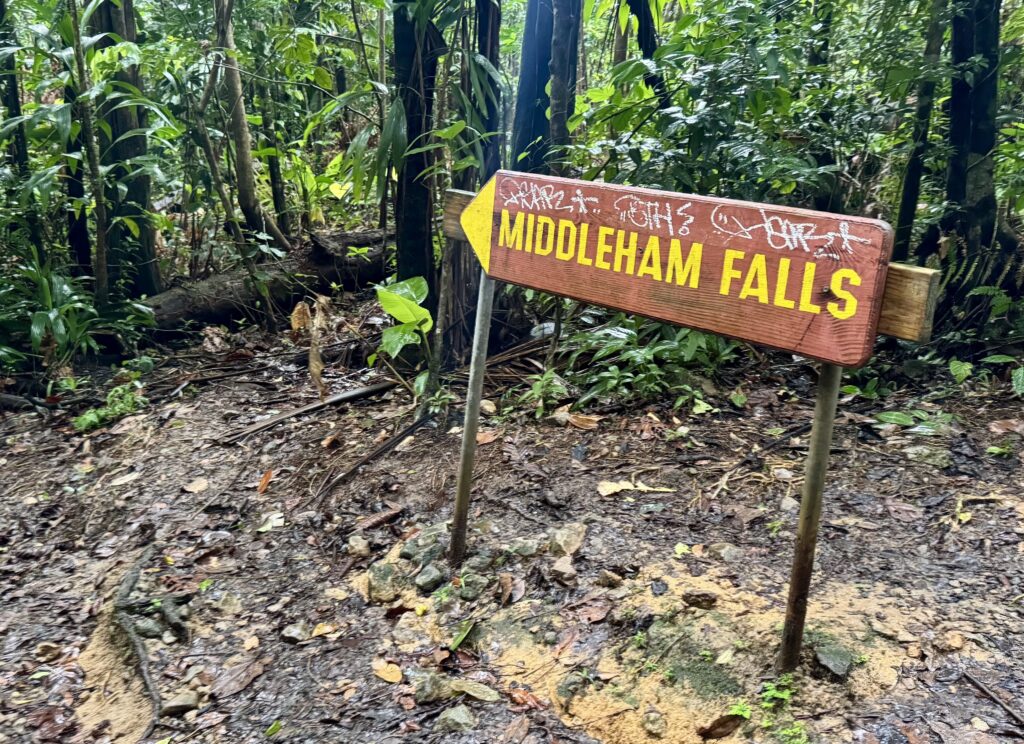
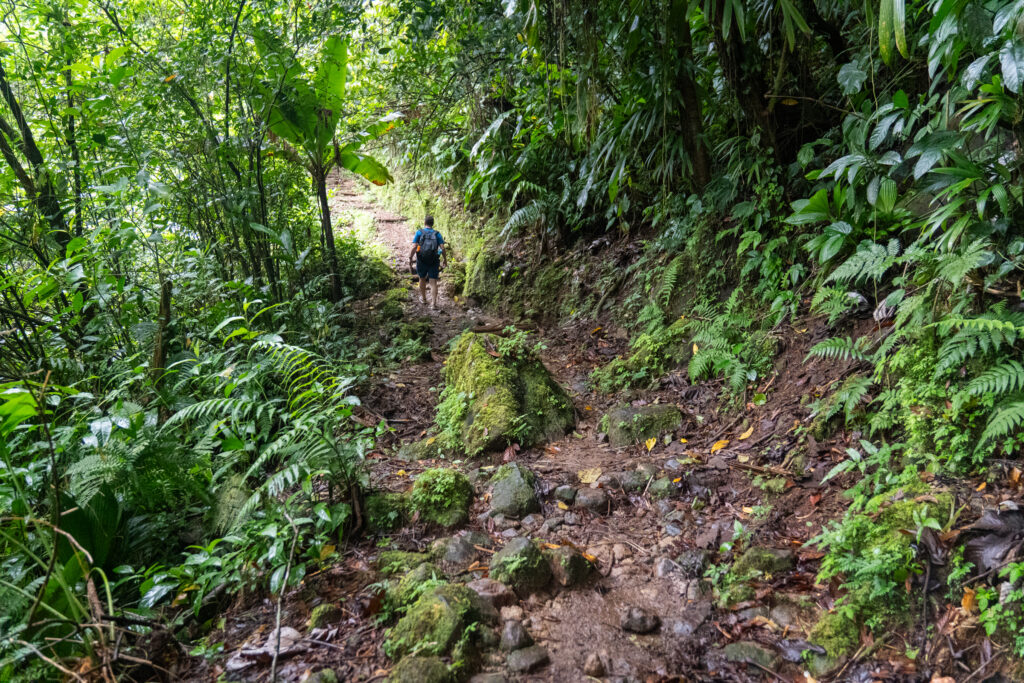
The hike to Middleham Falls is an out-and-back hike that is 5.3 km or 3.3 miles total and takes about 1.5-2 hours.
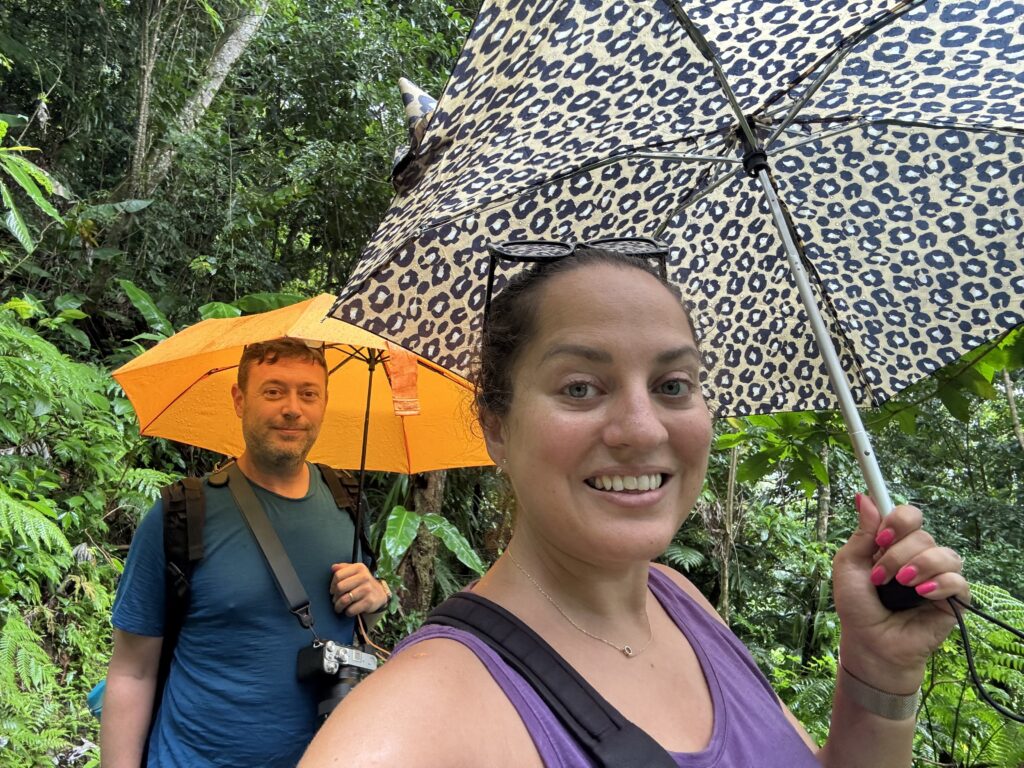
The hike started nicely, and soon the rain began to fall again. We didn’t mind it that much; we could handle it. Even when we passed a shaded gazebo that marked the halfway point, we didn’t feel the need to stop.
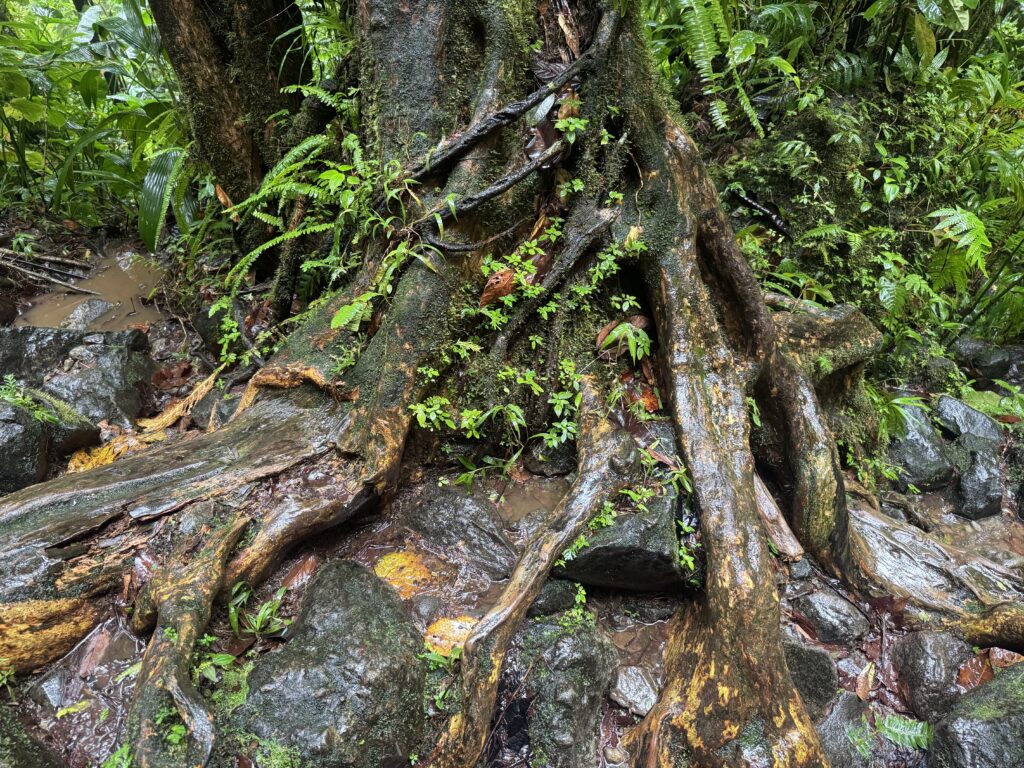
As we continued along dirt paths in the forest, climbing stairs into the hills, and stepping around giant tree roots, we breathed in that delicious forest air. The rain fell harder and harder, but the scent of the forest made me feel alive.
And there we were, probably a five-minute walk from the gorgeous waterfall, so close that we could hear the rush of water, and the trail…turned into a pile of rocks.
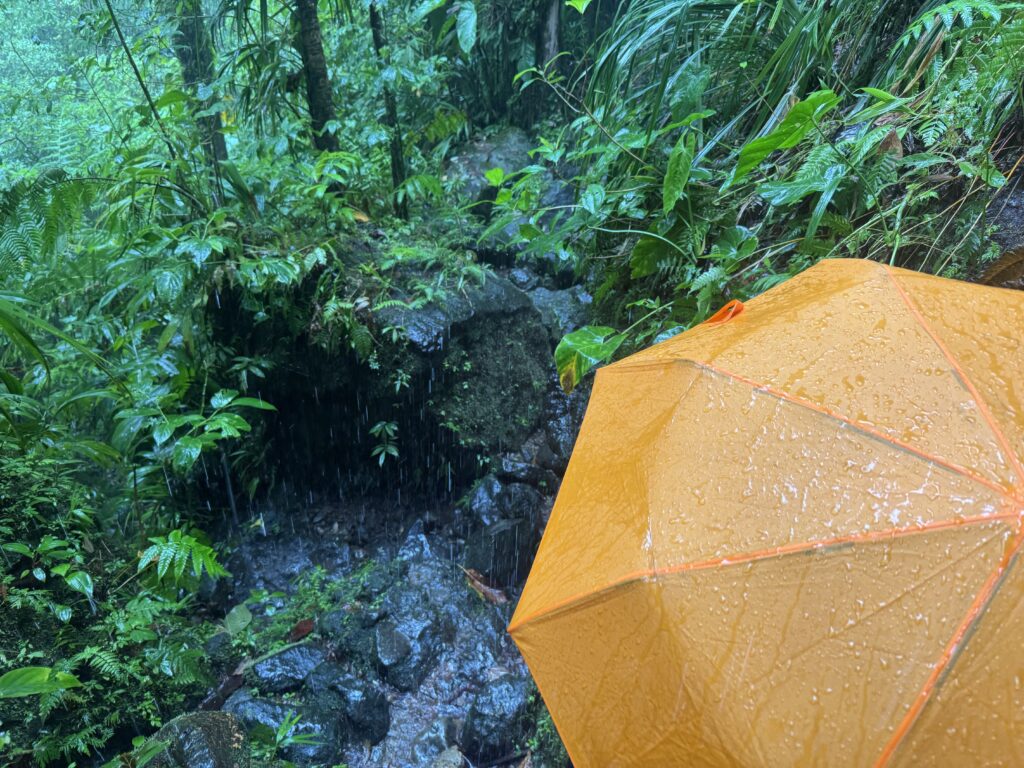
We would need to scramble on our hands and knees and climb down the boulders in order to get to the waterfall.
What the hell?!
The hike had been perfectly moderate until then, and nothing I’d read had mentioned scrambling.
We stood there, underneath our umbrellas, wondering if it was worth the risk. We would probably be fine. Or it could go very, very badly. And I did NOT want to risk hitting my head or breaking a bone in Dominica.
So we made the decision to call it. Five minutes from the waterfall. Oh well.
We hiked back to the gazebo at the halfway point to wait out the rain. The rain did not change whatsoever, and so we continued in the downpour.
Back at the car, I peeled off my soaked merino socks and squeezed out my hair. It was time to head to the hot springs.
Overall, Charlie and I thought this was a lovely hike until the end, and if it hadn’t been raining so hard, we would have tackled the scramble. But boulders plus sheets of rain was just too much.
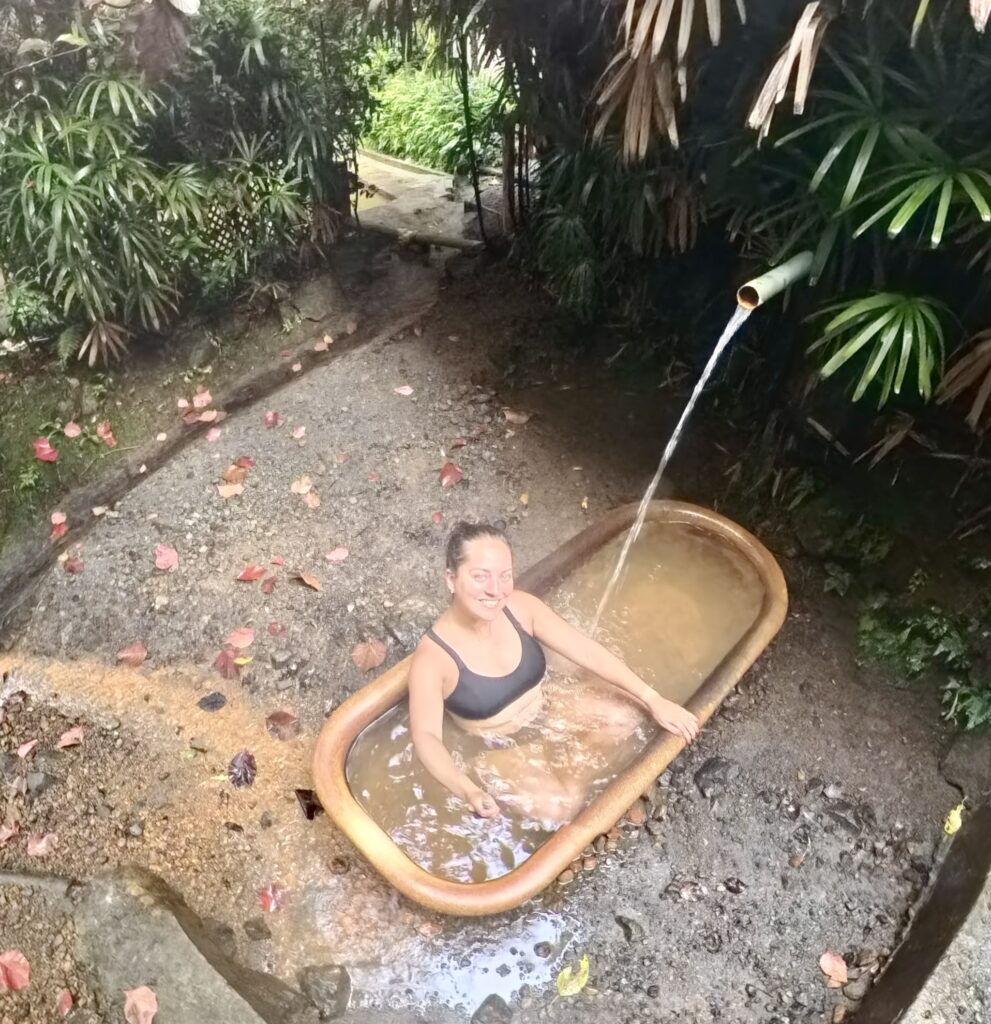
Wotten Waven Hot Springs and Ti Kwen Glo Cho
There are lots of “hot springs resorts” in the town of Wotten Waven, but Ti Kwen Glo Cho is one that came highly recommended to me. It’s a popular spot for cruise ship excursions during the day, but if you stay overnight, you can enjoy the pools without the crowds.
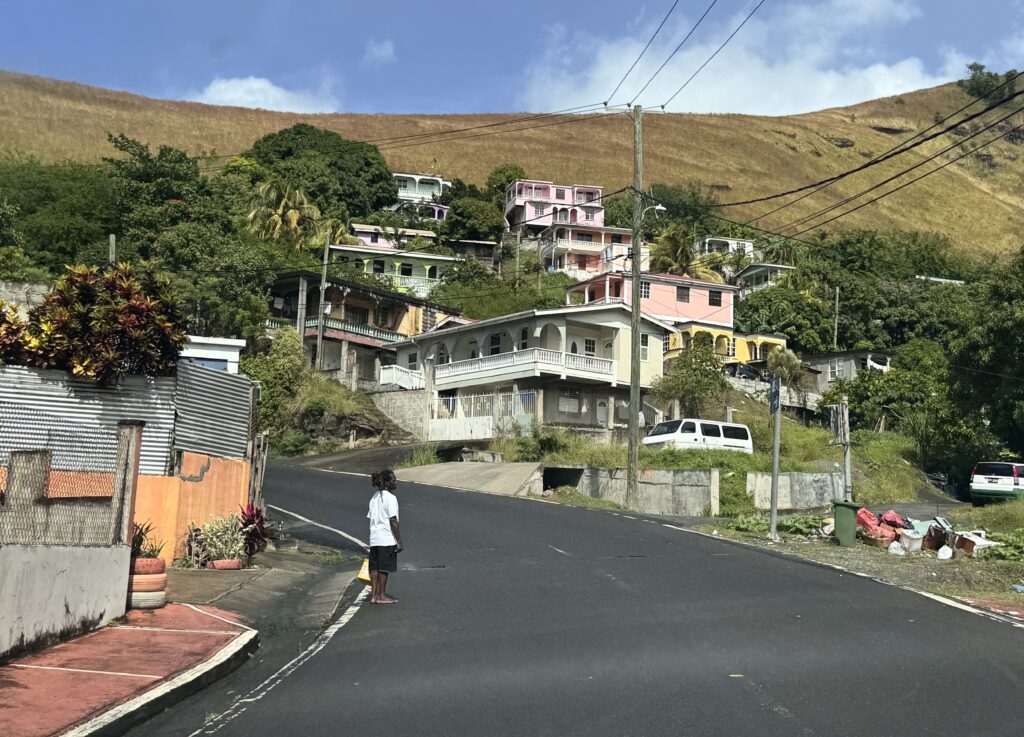
Wotten Waven is perched on a hill in the interior of the island, with lots of colorful houses and churches. We found Ti Kwen Glo Cho easily, checked in, and were given a simple, rustic room with bunk beds that could have accommodated a family with kids.
The grounds at the resort are beautiful, filled with flowers, fruit trees, and nicely manicured paths. From the check-in area, you walk down staircases built into the hills until you reach the pools.
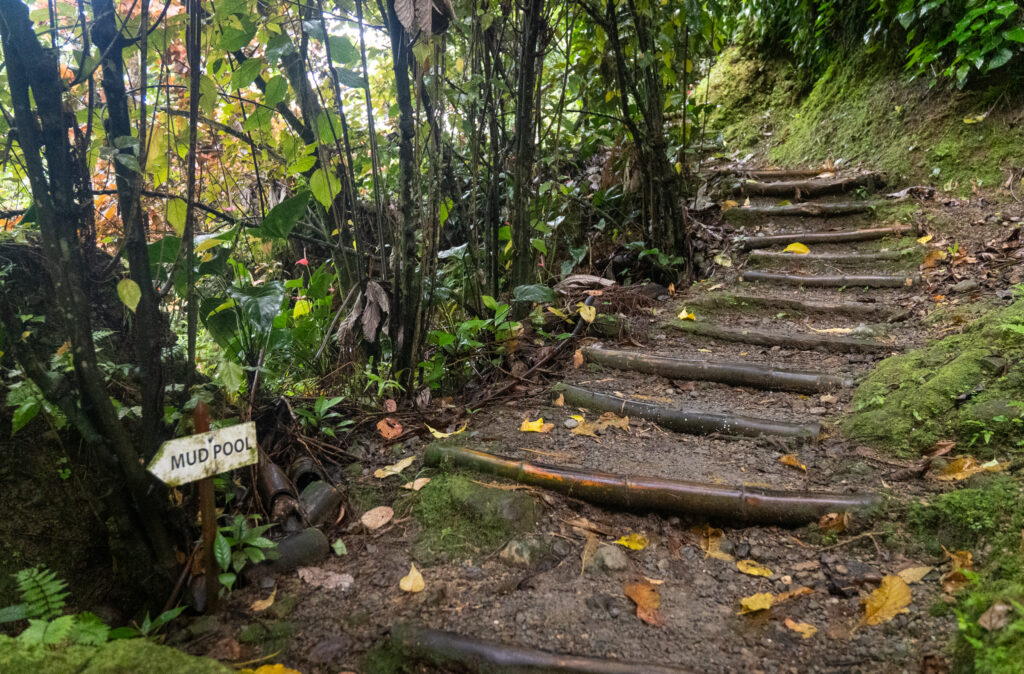
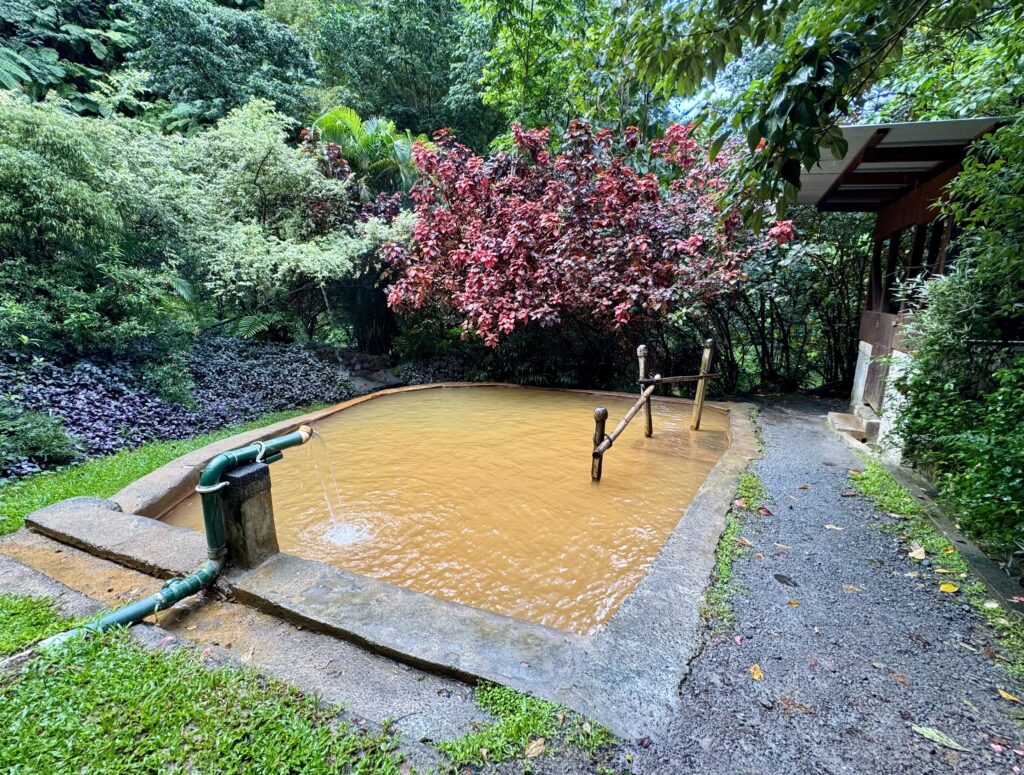
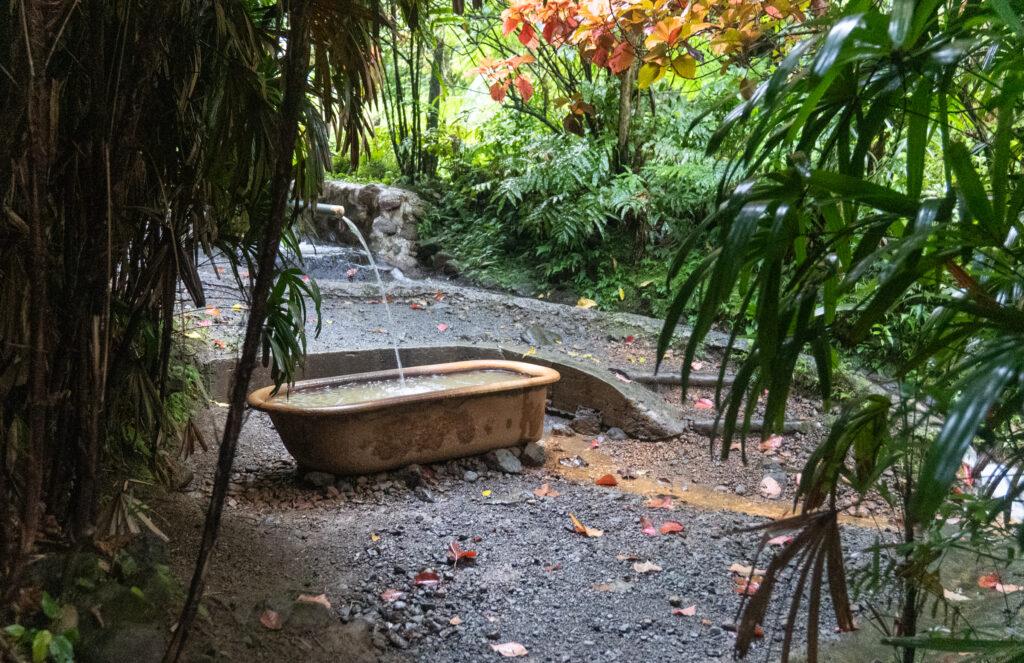
There are two pools — a “warm pool” and a “mud pool,” though to be honest they looked and felt the same — as well as a bathtub with a stream of water falling into it. A river flows behind the pools, and there’s a shaded changing area.
And while it was still raining, it felt absolutely divine slipping into that velvety warm water, surrounded by flowers as little cold raindrops dotted my cheeks. What a treat for sore muscles. By the late afternoon, we were two of only five people at the pools.
We did have one snafu — we went to the restaurant for dinner and the staff were annoyed that we hadn’t told them we wanted dinner when we checked in. That was our mistake.
If you want dinner, tell them when you check in. (They still fed us, and we had some delicious quesadillas.)
Something to keep in mind is that the walls are thin here. Staying in the room next to us was a family with two rambunctious kids, and just down the street was a Pentecostal church blasting its service.
Earplugs are always a smart thing to pack, wherever you travel, and that’s especially true for Ti Kwen Glo Cho.
A day visit at Ti Kwen Glo Cho costs $10 USD as of 2026, and double rooms with spa access start at $80 USD per night. Breakfast is $15 USD extra.
One thing I especially enjoyed is that Ti Kwen Glo Cho is owned by a local Dominican family. If you want to keep your money in local hands, this is a great place to do so.
A Day at the InterContinental
The next morning, Charlie and I took a final soak in the hot pools, had a tasty breakfast of eggs, beans, and plantains, and drove back to Portsmouth without incident.
And we decided to splurge.
By this time, we were tired of white-knuckling the terrible roads. Tired of being wet all the time. Tired of climbing stairs to get anywhere.
So we called the InterContinental and ordered day passes for the next day, at $37 USD each.
As we drove up that long driveway, I felt a bit embarrassed. Did I really travel to one of the least touristy places in the Caribbean, just to escape to a luxury resort? I roll my eyes at that kind of traveler.
And let’s talk about the most important part: it’s not like most Dominicans can pick up and spend the day at a luxury hotel when they need a break from their island. It’s not like they can decamp to a resort after a hurricane destroys their home.
That being said — luxury resorts, especially large resorts run by international chains like the InterContinental, are instrumental in growing Dominica’s tourism industry.
Yes, they employ locals, but they are also training locals in international hospitality standards. That training is critical to growing locally owned tourism in developing parts of the world.
I believe that many Dominican InterContinental employees will go on to open their own hotels and tourism businesses, and they’ll be better, more sustainable businesses as a result.
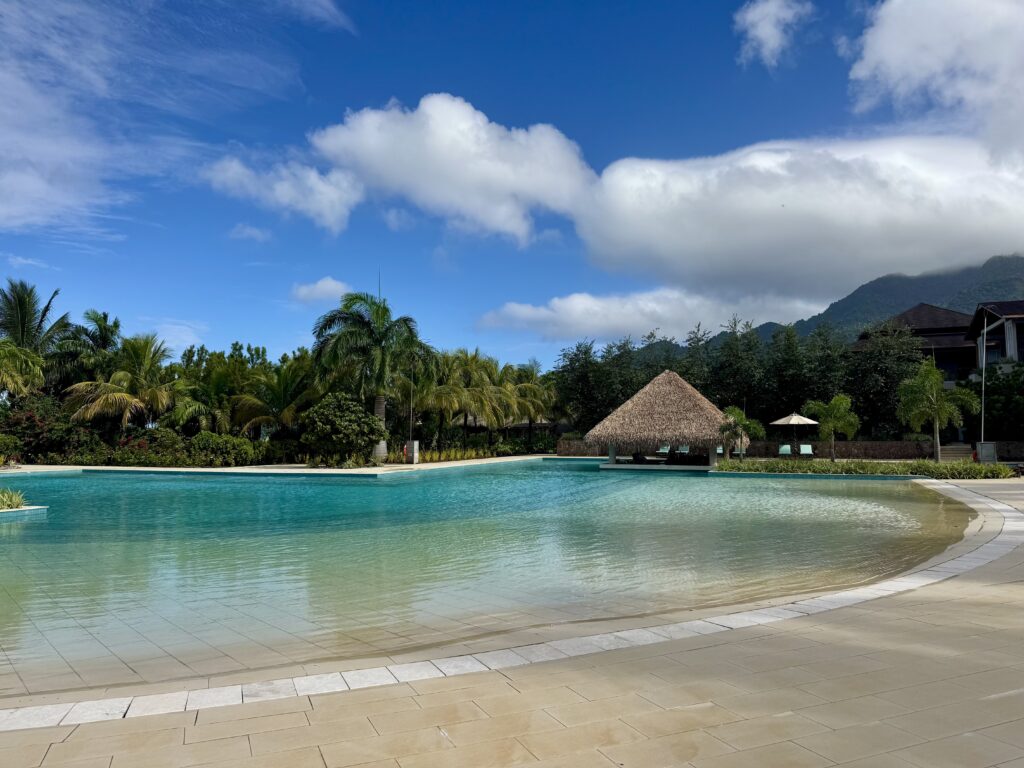
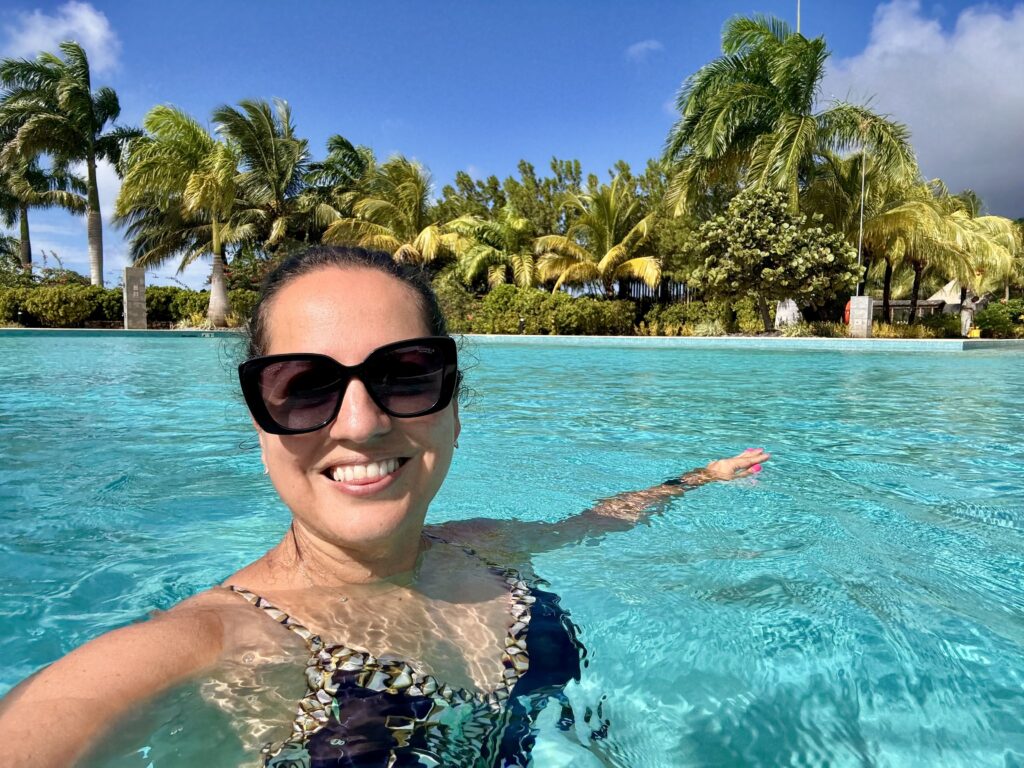
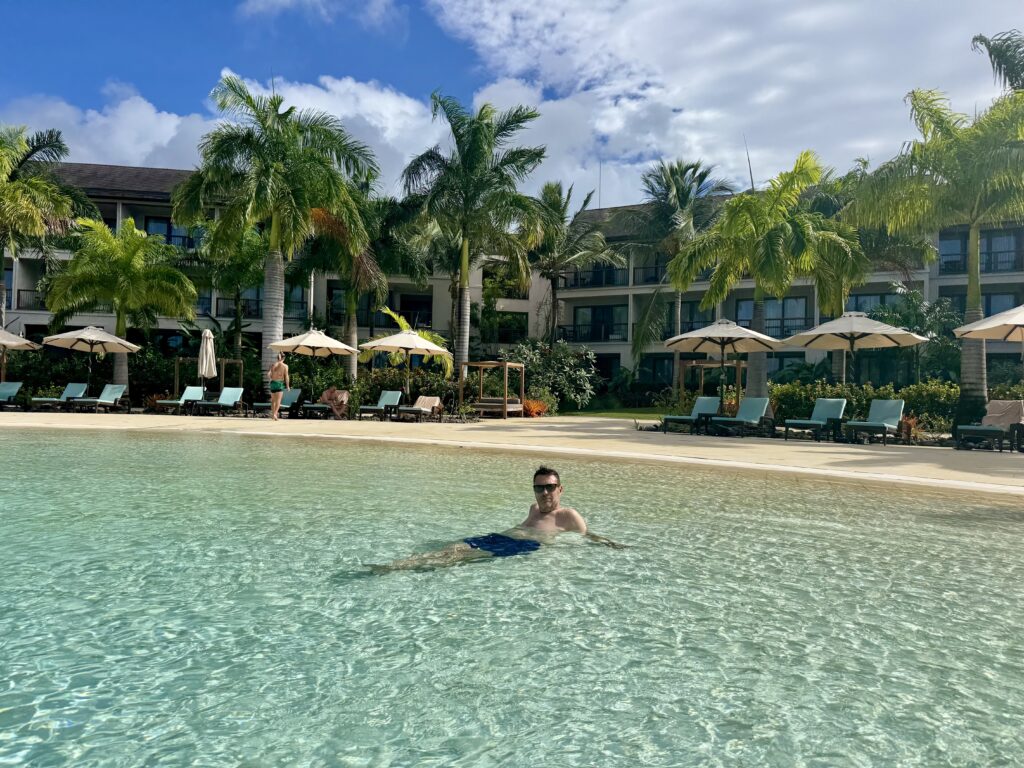
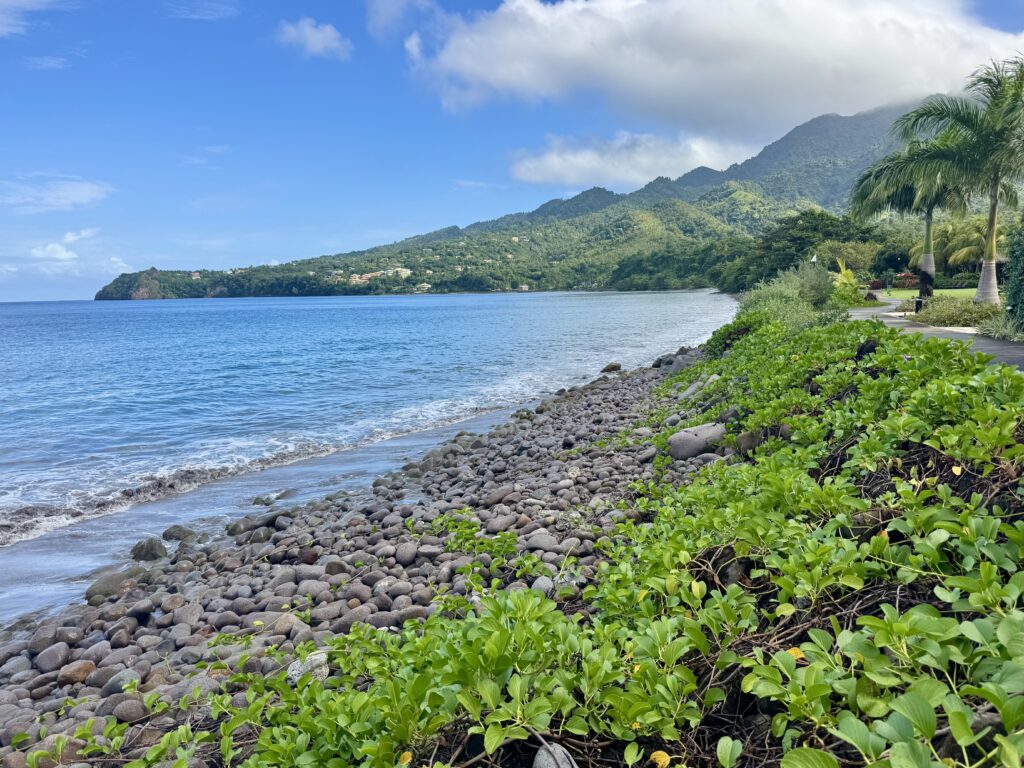
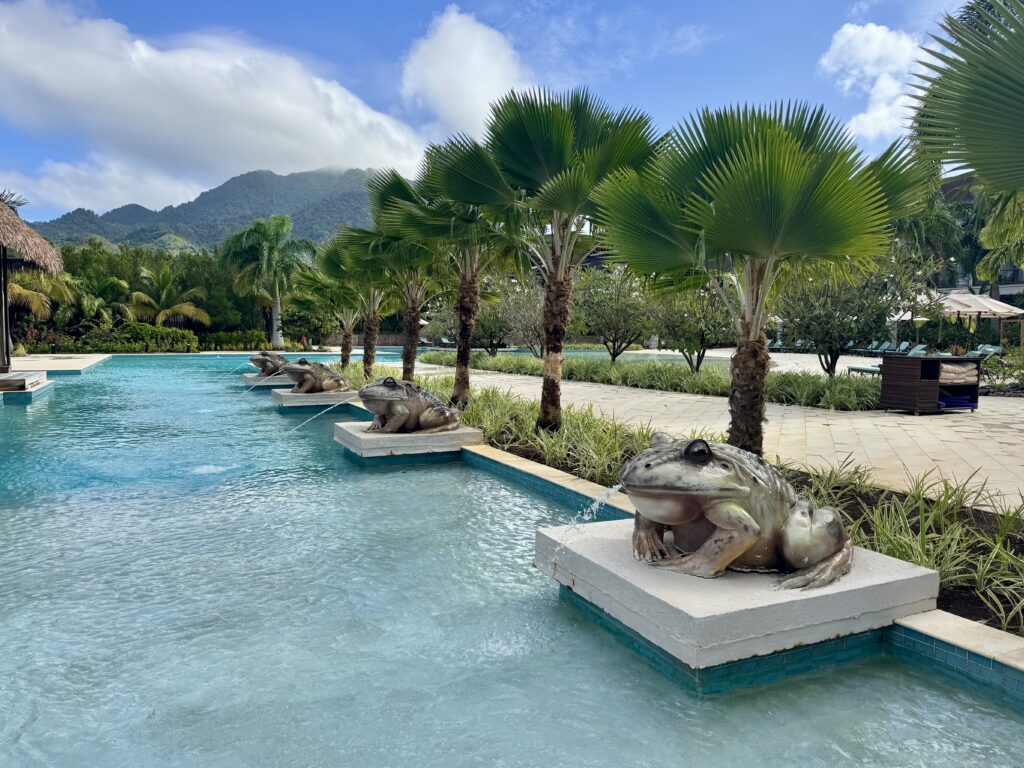
The InterContinental is perched on the coast, but there are no beaches. Instead, the pools feel a bit like the sea — you walk in and they deepen gradually.
And after the last several days, it was SO nice to sit on a lounger, read my Kindle, drink a coffee frappe, swim, and dry myself with a towel that was fluffy and not crispy, while enjoying the T-Pain-filled 2000s R&B playlist the resort was playing.
As usual, it rained hard for about 90 minutes. We spent that time in the restaurant. But this time, the sun actually came out afterward.
And those few hours of relaxation were exactly what we needed for the journey ahead.
Advance registration is required for day passes at the InterContinental Dominica Cabrits Resort & Spa. You can email [email protected] or call +1 767-445-1000. Passes are $37 USD on weekdays and $60 USD on weekends.
The Departure from Hell
Shortly before arriving in Dominica, we were notified that our WinAir flight from Dominica to St. Maarten had been rescheduled from 11:55 AM to 7:15 AM.
That threw a wrench into things — in order to make our flight, we would either need to leave Portsmouth in the middle of the night, or spend our final night by the airport.
I immediately vetoed driving on those roads after dark again, so we decided to shorten our stay at Kootney Resorts and drive to the town of Marigot while it was still light out the day before our departure.
At first I assumed we’d just stay at the airport hotel, but no, there was no airport hotel. There were actually no hotels near the airport. Just guesthouses.
No problem. We’d stay at a guesthouse. We booked the Golden Inn.
The drive back from Portsmouth to Marigot was terrifying once again, but I concentrated on breathing deeply through my fear, and I even managed to get a few photos.
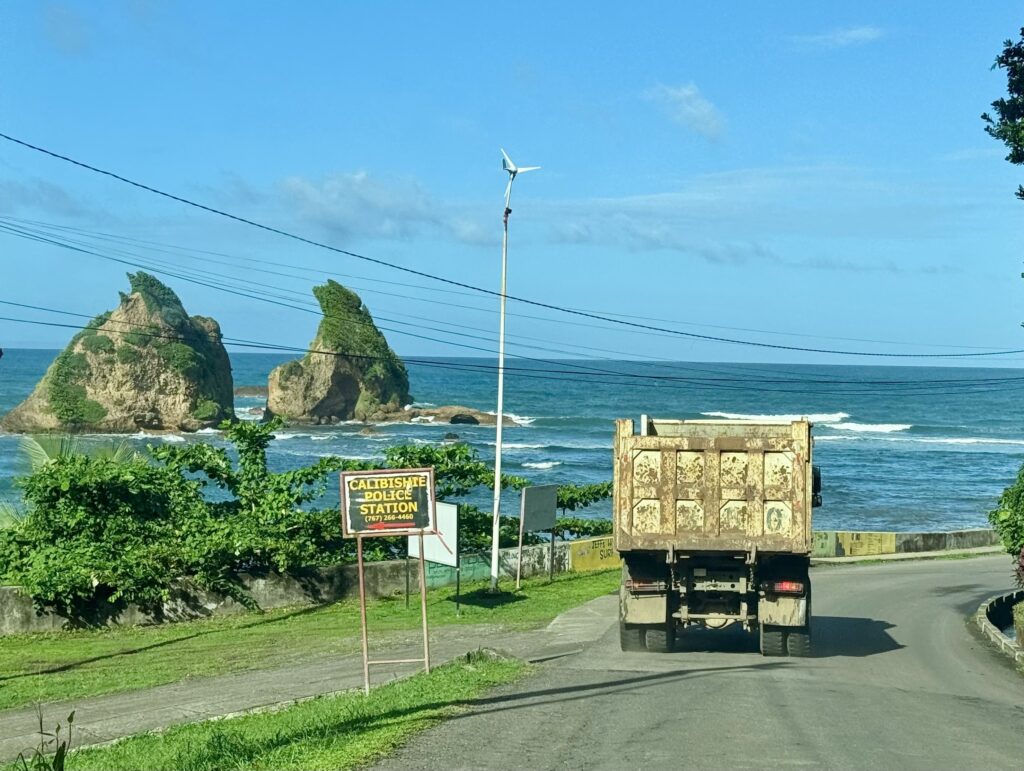
We pulled up to the Golden Inn and nobody was home except a little boy around 10 years old, who showed us to a room reeking of old shrimp with a dirty unmade bed.
“Is your mom going to be home soon?” I asked him. He shrugged.
“Okay. We’ll get some food and come back and talk to your mom, okay?”
“Okay.”
And off we set to find some dinner in the town of Marigot. Google Maps had a handful of restaurants on the map.
We headed to the first one, La Petite Bistro. It had been shuttered for a long time.
We headed to the next one, JU-C FRU-T SMOOTH-E HUT. Also shuttered.
We drove to the Last Flight Bar & Grill. It had an airplane sitting next to it, but the restaurant was just a shell.
“Let’s just find a minimart or something,” I told Charlie. “We can eat chips and cookies for dinner if we have to.”
There were no minimarts, no grocery stores, no convenience stores. We started pulling over and asking locals if there was a restaurant, a store, anywhere we could buy food. And each time, they would say, “Not here,” and shrug.
Desperate, I hopped back into the car after my latest fruitless inquiry with a shop owner. “Let’s just go to the airport,” I told Charlie. “There HAS to be something there.”
We drove to the airport — and THERE WAS AN OPEN RESTAURANT! It was 5:50 PM, they were closing in ten minutes, and all they had left were sandwiches and fries.

We returned to the Golden Inn, where the owner was now home and had made up a clean bed for us. The shrimp smell was still terrible, but by that point, we weren’t going anywhere else.
And by then, we were expecting to just get out of Dominica with no further issues, but no, there was one more surprise planned to send us off! Our luggage was too heavy, the WinAir worker told us, and we would need to pay more.
“Fine,” I said. “I don’t care. We’ll pay.”
“And the machine isn’t working,” she said. “We can only take cash.”
“FINE,” I said through gritted teeth. “I will go to the ATM.” I would have paid whatever they asked.
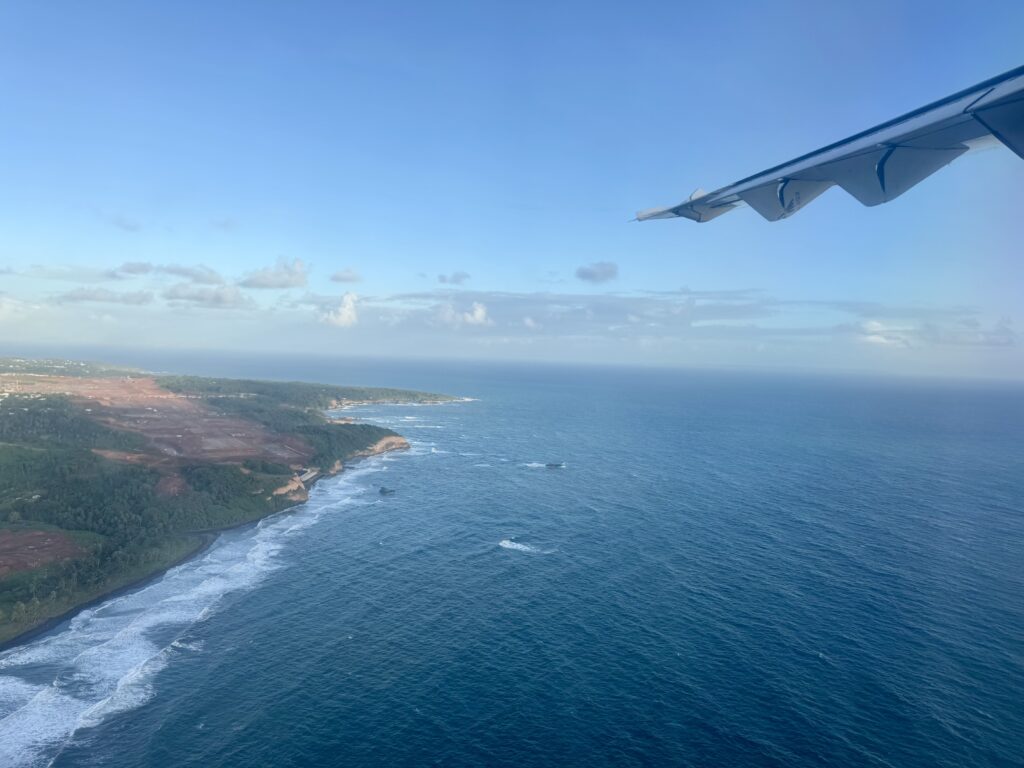
As our flight took off, cresting over the hills of Dominica, I squeezed Charlie’s hand and sighed with relief. I have never been so relieved to leave an island.
What I Would Have Done Differently
So, if you’re reading this and you’d be interested in visiting Dominica, but doing it in a much better way than I did, that’s great!
Let me tell you what I would have done differently.
I would not have rented a car. I would have hired drivers. Even though Charlie drove well in Dominica, the scary drives turned me into a basket case, which is not how anyone should spend their vacation.
I would have stayed in the Roseau area for at least some of the time. Roseau is the most developed part of the island, with much better roads, the greatest variety of accommodation and restaurants, and most tours depart from here (though they’re primarily designed for cruise ship excursions).
While I enjoyed Portsmouth and especially staying at Kootney Resorts, I think it would be better suited for a shorter duration.
When I found out about the flight being rescheduled to early in the morning, I would have hired a driver to take us VERY early in the morning. It was absolutely not worth spending a night in Marigot.
I would have visited during the driest months of the year. While the dry season in Dominica technically runs from December to May, the driest months are February, March, and April.
I would not have trusted Google Maps, especially for restaurants. So many of the restaurants listed as active and open on Google Maps had been closed for months. I don’t know if this would have helped, but it would have kept my expectations in check.
I would have considered taking the ferry to Roseau rather than flying in. There is a passenger ferry called the FRS Express des Îles that runs from Guadeloupe to Dominica to Martinique to St. Lucia. While that didn’t work for our particular trip, this is a great way to avoid the airport altogether.
I would have packed backup protein bars. I always pack protein bars when traveling solo, and eat them when I arrive late or don’t feel like going out, but I don’t when traveling with Charlie, as he would NOT be happy eating a protein bar for dinner. But they would have saved us on the final night.
Is Dominica worth visiting?
Overall, I feel like Dominica is worth visiting if you’re a certain kind of traveler — the kind of traveler who genuinely enjoys visiting less developed places and relishes the challenges of travel.
(And no, I’m not talking about the people who THINK they should enjoy visiting less developed places — I mean people who genuinely prefer them.)
Dominica is also a nice choice for people interested in outdoor exploration and hiking, especially hardcore hiking, but not beaches.
But you need to be both of these things: an outdoorsy person AND a person who enjoys the challenges of less developed countries. If I were traveling for outdoor exploration and hiking, I’d visit Costa Rica or Guatemala in a heartbeat before returning to Dominica, because they have much better travel infrastructure.
Additionally, if you’re visiting Dominica, you need to be okay with a LOT of rain, including rain while hiking, swimming, and hot spring-basking.
My friend’s parents owned a house in Dominica for many years, until Hurricane Maria destroyed it. Her dad is the kind of person who enjoys being on a tropical island, far away from everyone, ESPECIALLY tourists.
Back in 2022, Charlie and I happened to be in Puerto Vallarta when our friend’s dad passed through for one night after a vacation on the Oaxaca coast. We met up, and Charlie asked him how he liked Vallarta.
“I’M NEVER COMING HERE AGAIN!” he yelled.
For him, Dominica was perfect. (“He would still be there if he weren’t 78 years old,” my friend told me.)
Would I go back to Dominica? To be completely honest, I don’t see the need to return. But not in a “I would NEVER go back!” way.
There are so many Caribbean islands I would rather return to than Dominica (Bequia, Curaçao, Martinique, and St. Lucia, among others). Not to mention the Caribbean islands I haven’t visited yet (Anguilla is hopefully next).
Our time on this planet is limited. I’d rather spend my time exploring places I want to see, not returning to a place I didn’t love just to make a point.
I feel like I’ve given Dominica a chance, and even though the trip was challenging, I still had some moments of joy, like the Indian River trip, most of the hike to Middleham Falls, and our time at Wotten Waven.
Dominica is not the place for me. But it might be the place for you.
Does Dominica sound like your kind of place?